
Weekly Review & Indian Stock Market Prediction (Oct 05th – Oct 09th, 2026)
Nifty fell 3.11% WoW to 22,421.95, marking its eighth straight weekly decline amid FII selling, high crude prices and rising bond yields. Full recap & outlook for October 5–9.


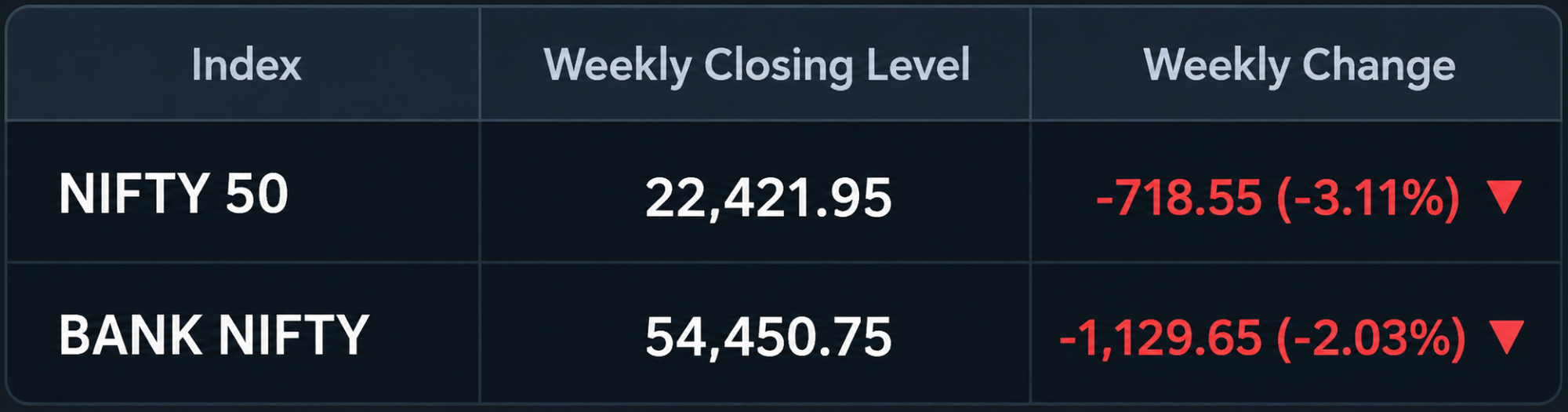
Indian equity markets ended another volatile and sharply negative week, with the benchmark indices recording their eighth consecutive weekly decline, marking their longest weekly losing streak in 25 years. The Nifty 50 declined 718.55 points (-3.11%) to close at 22,421.95, while the Sensex fell 1,986.04 points (-2.69%) to end at 71,909.70. The Bank Nifty slipped 1,129.65 points (-2.03%) to close at 54,450.75.
The Nifty traded between 22,217.30 and 23,080.25 during the week, reflecting sustained selling pressure and heightened volatility. Markets remained under pressure throughout the shortened week as crude oil prices stayed elevated, U.S. Treasury yields climbed to multi-decade highs, the rupee weakened and foreign investors continued aggressive selling. Thursday saw another sharp decline, although strong buying in IT stocks helped cushion the broader fall.
The upcoming week from October 5 to October 9, 2026 will have five trading sessions and is expected to remain event-heavy. The biggest domestic trigger will be the RBI Monetary Policy Committee meeting from October 5–7, with the policy decision scheduled for Wednesday, October 7. A Reuters poll shows a majority of economists expect the RBI to raise the repo rate by 25 basis points to 5.50%. The September-quarter earnings season will also begin, with TCS results putting the IT sector in focus.
Weekly Market Review.
Market Summary: Sensex & Nifty 50 Performance
Monday September 28: Indian markets began the week with a sharp sell-off as stalled U.S.-Iran negotiations pushed crude oil prices higher. The Nifty declined 360.25 points (-1.56%) to 22,780.25, while the Sensex fell 1,124.02 points (-1.52%) to 72,771.72. Bank Nifty declined sharply as well, with banking and financial stocks among the major drags. Brent crude surged around 3.7% to $108 per barrel, increasing concerns over inflation, India's import bill and corporate margins. All 16 major sectoral indices ended lower.
Tuesday September 29: Markets extended losses for a second consecutive session amid elevated crude oil prices, rising global bond yields and heavy FII selling. The Nifty declined 64.05 points (-0.28%) to 22,716.20, while the Sensex fell 242.65 points (-0.33%) to 72,529.07. Monthly derivatives expiry added to intraday volatility. Thirteen of the 16 major sectors ended lower, while FIIs recorded a massive ₹9,980.22 crore net outflow.
Wednesday September 30: Markets remained under pressure for a third consecutive session. The Nifty declined 95.75 points (-0.42%) to 22,620.45, while the Sensex slipped 48.78 points (-0.07%) to 72,480.29. Banking stocks showed relative resilience, but weakness in Pharma, Metal and Consumer Durables weighed on broader sentiment. September ended as one of the weakest months of 2026, with persistent FII selling, elevated crude prices and global bond-market stress dominating sentiment.
Thursday October 1: Markets ended the holiday-shortened week sharply lower. The Nifty declined 198.50 points (-0.88%) to 22,421.95, while the Sensex fell 570.59 points (-0.79%) to 71,909.70. Bank Nifty declined 182.30 points (-0.33%) to 54,450.75. India VIX jumped 7.15% to 14.455, reflecting higher volatility. IT was the standout sector, gaining 2.17%, while Auto declined 3.46%, Metal lost 2.35%, Consumer Durables fell 1.91%, FMCG dropped 1.61% and Realty slipped 1.46%.
Friday October 2: Indian equity markets remained closed for Mahatma Gandhi Jayanti.
Week-on-week: Nifty declined 718.55 points (-3.11%) to 22,421.95, Sensex fell 1,986.04 points (-2.69%) to 71,909.70, while Bank Nifty dropped 1,129.65 points (-2.03%) to 54,450.75. The Nifty and Sensex completed their eighth straight weekly decline, with cumulative losses over the eight-week period reaching approximately 8.7% and 8.4%, respectively.
Share Market Live News: The Big Macro Triggers This Week
1. Nifty Records Eighth Consecutive Weekly Decline
The Nifty ended the week 3.11% lower at 22,421.95, marking its eighth consecutive weekly decline and extending the benchmark's longest weekly losing streak in around 25 years. The Sensex also registered an eighth straight weekly decline.
The Nifty touched a weekly low of 22,217.30, making the 22,200 zone an important near-term technical level. The index has now lost approximately 8.7% over the eight-week declining streak.
On the upside, repeated selling above 22,600–22,700 indicates that the market will need to reclaim this region before the short-term structure begins to improve.
2. Crude Oil & Middle East Developments Remain Critical
Crude oil remained one of the biggest drivers of Indian equities during the week.
Brent crude surged to around $108 per barrel on Monday after U.S.-Iran negotiations stalled, contributing to the week's initial sharp sell-off. Although prices subsequently moderated, crude remained elevated and moved back above $100 per barrel by Thursday amid renewed supply concerns.
For India, sustained crude prices near or above $100 remain important because of their potential impact on inflation, the rupee, government finances, corporate margins and the external balance.
Energy prices will therefore remain one of the biggest global triggers for Indian equities during the October 5–9 week.
3. Global Bond Yields Keep Markets on Edge
Elevated global bond yields continued to weigh heavily on risk sentiment.
The U.S. 10-year Treasury yield climbed above 5.3%, touching its highest level since 2002, as global bond markets faced renewed selling pressure. Higher yields increase the attractiveness of U.S. fixed-income assets and can put additional pressure on capital flows into emerging markets such as India. Reuters
Rising global yields also contributed to weakness in the rupee and pushed India's benchmark bond yield to its highest level in around two years.
Markets will therefore remain highly sensitive to movements in U.S. yields and expectations surrounding further Federal Reserve tightening.
4. India VIX Climbs Above 14
Volatility increased substantially during the week as the equity sell-off intensified.
India VIX ended Thursday at 14.455, up 7.15% for the session, reflecting rising expectations of larger short-term market swings.
The rise in volatility comes ahead of an important week featuring the RBI monetary policy decision, global macro data and the beginning of India's Q2 earnings season.
Although the VIX remains well below extreme stress levels, the move above 14 indicates that market participants are pricing in greater uncertainty than earlier in September.
5. Sector Rotation Remains Highly Selective
Sector performance remained heavily skewed toward the downside during the week.
Reuters reported that 15 of the 16 major sectoral indices ended the week lower, with IT being the only sector to finish in positive territory, gaining roughly 0.5% for the week. Auto and Consumer Durables were among the weakest sectors.
Thursday's sector performance highlighted this divergence:
- IT: +2.17%
- Financial Services: -0.38%
- Pharma: -0.48%
- Energy: -0.68%
- Realty: -1.46%
- FMCG: -1.61%
- Consumer Durables: -1.91%
- Metal: -2.35%
- Auto: -3.46%
The stronger relative performance in IT came ahead of the September-quarter earnings season, although analysts continue to expect muted growth for major Indian technology companies because of cautious global client spending and AI-led pricing pressure.
Top Nifty Gainers & Losers Last Week
Top Gainers (1-Week Performance)
- KOTAK MAHINDRA BANK: +3.55% | ₹418.35
Kotak Mahindra Bank emerged as the strongest Nifty performer for the week despite broader weakness across financial stocks. The stock displayed strong relative strength even as Bank Nifty declined more than 2% for the week. - INFOSYS: +3.48% | ₹1,035.00
Infosys outperformed the benchmark as buying returned to IT stocks toward the end of the week. The broader Nifty IT index was the only major sectoral index to finish the week in positive territory. - HDFC LIFE: +0.60% | ₹534.20
HDFC Life remained resilient despite broad-based weakness across domestic equities and ended among the few Nifty constituents to record a weekly gain.
Top Losers (1-Week Performance)
- BAJAJ AUTO: -10.96% | ₹10,045
Bajaj Auto witnessed the sharpest decline among the major Nifty losers during the week. The stock came under sustained selling pressure alongside weakness across the broader Auto sector, which was one of the worst-performing sectors during the week. - APOLLO HOSPITALS: -8.50% | ₹8,133.50
Apollo Hospitals remained under heavy selling pressure during the week and significantly underperformed the broader Nifty. - TITAN: -7.54% | ₹4,515.70
Titan witnessed sustained weakness as selling pressure remained elevated across consumer-oriented stocks. Consumer Durables was among the worst-performing sectors of the week.
Institutional Activity: FIIs vs. DIIs
Institutional flows remained sharply divergent during the week, with aggressive FII selling being largely absorbed by strong DII buying. Foreign Institutional Investors (FIIs) recorded cumulative net outflows of approximately ₹34,966.07 crore across the four trading sessions. The highest FII selling was witnessed on Wednesday, 30 September, at ₹10,148.41 crore, followed by Tuesday at ₹9,980.22 crore and Thursday at ₹9,484.22 crore. FIIs remained net sellers throughout all four sessions.
Domestic Institutional Investors (DIIs) continued their strong buying momentum, registering total net inflows of around ₹33,455.30 crore during the period. The highest DII buying was recorded on Wednesday at ₹11,271.73 crore, followed by Thursday at ₹10,041.84 crore and Tuesday at ₹6,952.71 crore. DIIs remained consistent net buyers across all four trading sessions.
Overall, combined institutional flows stood at approximately ₹1,510.77 crore of net outflows, indicating that strong domestic institutional participation absorbed a significant portion of the heavy foreign selling. Persistent FII outflows continued to weigh on sentiment, while sustained DII buying provided an important cushion and helped limit broader market pressure.
Market Outlook & Nifty Prediction for October 5 – October 9, 2026
Nifty enters the upcoming week at 22,421.95 after recording its eighth consecutive weekly decline.
The weekly chart shows the index continuing to remain under significant selling pressure, with this week's high restricted to 23,080.25, while the low slipped to 22,217.30.
This makes 22,200–22,150 the most important immediate support zone going into the new week.
A sustained break below 22,200 could expose the index towards 22,000 and 21,800, while a recovery above 22,600–22,700 would improve the immediate structure and could open the way towards 22,900–23,000.
Expected range: 21,800 – 23,000
Support:
22,200–22,150 (immediate support zone)
22,000 (psychological support)
21,800 (next major support)
Resistance:
22,600–22,700 (immediate resistance)
22,900–23,000 (major hurdle)
Bank Nifty:
54,000–53,800 support, 54,900–55,200 immediate resistance and 55,400–55,500 major resistance.
Key triggers:
(1) RBI Monetary Policy on October 7 will be the biggest domestic macro trigger of the week. The MPC will meet from October 5–7, with a Reuters poll showing around 60% of economists expecting a 25-bps repo-rate increase to 5.50% as inflation broadens and the rupee remains under pressure.
(2) Crude oil and Middle East developments will remain among the biggest global triggers, especially with Brent continuing to trade around the psychologically important $100-per-barrel region.
(3) U.S. Treasury yields and global rate expectations will remain important for emerging-market sentiment. The U.S. 10-year yield has climbed above 5.3%, its highest level since 2002.
(4) FII selling, DII support and the rupee will remain key domestic liquidity indicators. The rupee weakened to around 96.3150 per U.S. dollar on October 1, its lowest level in two months.
(5) Q2 FY27 earnings season will begin to move into focus. Indian IT companies will be closely watched, with TCS among the first major companies due to report. Analysts surveyed by Reuters expect the sector to deliver one of its weakest quarterly performances in around three years amid cautious client spending and AI-led pricing pressure.
(6) Global macroeconomic data, particularly U.S. employment, inflation and activity indicators, could influence Treasury yields and Federal Reserve policy expectations.
(7) Technically, Nifty holding above 22,200 or reclaiming 22,600–22,700 could determine the next directional move.
Strategy: Maintain a selective approach while Nifty remains below the 22,600–22,700 resistance zone. The 22,200 level is the key downside pivot after being tested during the week. A sustained move below this zone could expose 22,000 and 21,800, while reclaiming 22,700 could lead to a recovery attempt towards 22,900–23,000. Rather than chasing short-term rebounds, traders can watch for confirmation around these levels, particularly around the RBI policy announcement. IT stocks showed relative strength during the latest week, while Auto, Consumer Durables and select cyclicals remained under pressure.
Stocks to Watch & Investment Opportunities
Five stocks showing notable relative strength, momentum or important price action going into the holiday-shortened week:
- KOTAK MAHINDRA BANK
Kotak Mahindra Bank gained 3.55% during the week to ₹418.35, significantly outperforming the broader market. The stock received additional support after the RBI approved Anup Kumar Saha as the bank’s next MD & CEO, providing greater leadership clarity. With the RBI policy decision due on October 7, the stock could remain in focus next week. - INFOSYS
Infosys gained 3.48% during the week to ₹1,035, showing strong relative strength as IT emerged as the only major sector to finish the week higher. However, the September-quarter earnings outlook for the sector remains cautious, with analysts expecting weak client spending and AI-led pricing pressure. Continued strength in Infosys could therefore make it an important stock to track ahead of the IT earnings season. - TCS
TCS will be one of the most closely watched stocks next week as the Q2 FY27 earnings season begins. Investors will focus on revenue growth, margins, deal wins, AI demand and management commentary. Expectations for Indian IT remain relatively muted, which could make the results an important trigger for the entire sector. - MARUTI SUZUKI
Maruti Suzuki could remain in focus after reporting double-digit sales growth in September, supported by strong urban passenger-vehicle demand and the upcoming festive season. With broader Auto stocks under significant pressure last week, Maruti's relatively stronger operating data makes it one of the key auto names to monitor for signs of sector recovery. - BAJAJ AUTO
Bajaj Auto declined 10.96% during the week to ₹10,045, making it one of the sharpest Nifty losers. September domestic two-wheeler sales fell around 12% year-on-year, adding to concerns over rural demand. After such a steep weekly correction, the stock will be important to track for either price stabilisation or continued weakness around recent lows.
💡 Pro-Tip: Want a real-time technical analysis for these stocks? Ask LiMo, our AI co-pilot, for an instant buy/sell rating.
Discover Investment Opportunities with Liquide
Available on both Google Play Store and Apple Appstore, Liquide offers up-to-date market analysis, expert recommendations and real-time insights to guide your investment decisions.
Download the Liquide App today and enhance your financial journey.
Disclaimer: The information provided in this article is for informational and educational purposes only and does not constitute financial, investment or trading advice.
Stock, commodity and currency markets involve significant risk. Readers are strongly advised to consult with their financial advisors before making any investment decisions.
For a detailed Disclaimer, please visit our website https://liquide.life/