
Why Gold and Silver Are Falling Despite the 2026 Iran-US War
Why are Gold and Silver falling despite the 2026 Iran-US war? With gold facing its longest losing streak since 2024 and silver dropping 40%, the safe-haven narrative has decoupled. Is this correction creating a strategic entry point for investors in 2026?

The outbreak of the Iran-US conflict in late February 2026 was widely expected to trigger a classic "flight to safety." Historically, war equals a rush into bullion.
Yet, as of late March 2026, the market is witnessing a staggering geopolitical paradox: gold and silver are crashing while the war is escalating.
If you are holding precious metals expecting a "moonshot," the current data presents a sobering reality. Here's a data-driven breakdown of why the safe-haven narrative has decoupled from the charts.
2026: A Tale of Two Trends
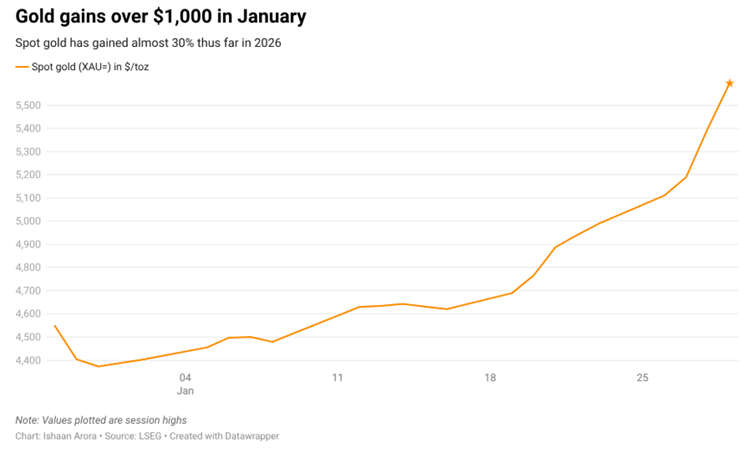
In the immediate wake of the conflict on February 28, 2026, gold initially behaved as expected, touching multi-week highs as traders dumped risk assets.
Then, the rally fizzled.
Key Data Points:
- Gold’s Longest Streak: Gold recorded six consecutive sessions of losses in mid-March, its most dismal performance since 2024.
- Correction Magnitude: From its late-January peak of nearly $5,600/oz, spot gold retreated roughly 27%, touching a four-month low of $4,098/oz by 23rd March.
- Silver’s Volatility: Silver, the industrial-precious hybrid, plummeted more than 40% from recent peaks, briefly hitting $65–$70/oz—a far cry from its January record of $120/oz.
4 Reasons Why Gold, Silver are Failing in 2026
Why are the world’s ultimate hedges failing during a major war? The answer lies in a complex intersection of liquidity, energy and monetary policy.
1. Rising Oil Prices (The "Energy Hedge")
Since the conflict erupted, Brent crude surged over 40%, crossing the $100/barrel mark due to the closure of the Strait of Hormuz.
- Siphoned Demand: Energy has replaced bullion as the primary tactical refuge.
- Inflationary Pressure: Soaring energy costs have fuelled "stagflation" fears, prompting markets to bet on fewer interest rate cuts by the Federal Reserve.
2. The Fed's "Higher for Longer" Stance
Despite the war, the Federal Reserve has held policy rates at 3.5%–3.75%.
- Non-Yielding Burden: Gold and silver offer zero yield. When government bond yields remain elevated, the opportunity cost of holding bullion becomes too high for institutional desks.
- Treasury Rotation: Investors are rotating out of metals and into U.S. Treasuries, which now offer both safety and a high nominal yield.
3. The Mighty Dollar (USDX)
- Precious metals are priced in Dollars. The U.S. Dollar Index (DXY) has seen a sharp reversal, strengthening as a result of the risk-off sentiment and its positive correlation with oil prices.
- A stronger Greenback makes gold significantly more expensive for international buyers, dampening physical demand.
4. The 2025 "Profit-Booking" Echo
We cannot ignore the context of 2025. Gold had a spectacular year, soaring ~65% in 2025, while Silver surged ~150%.
- Exit Liquidity: For many institutional funds, the initial war-induced spike provided the perfect exit liquidity to book massive profits.
- Double Whammy for Silver: Because silver is vital for AI infrastructure and solar energy, concerns over a war-induced global economic slowdown have hurt its industrial demand outlook.
Investor’s Takeaway: Is the Safe Haven Dead?
Hardly. Gold and silver remain vital long-term stores of value. However, the 2026 conflict teaches us three critical lessons:
- Context is Everything: Geopolitics does not exist in a vacuum; it competes with bond yields and currency fluctuations.
- Liquidity Crushes Narrative: In the heat of a prolonged conflict, the "need for cash" to cover margin calls often overrides the "need for safety."
- A Tool, Not a Fortress: Gold is an instrument for risk management—not a magical shield immune to the laws of liquidity.
Should You Buy Gold and Silver Now?
The recent fall is likely a healthy consolidation phase within a larger bullish trend. While 2025's 60%+ returns were an anomaly (gold’s 30-year average is closer to 8%-10%), the fundamental case remains strong.
Strategic Recommendations:
- New Investors: View this as an entry opportunity. Instead of timing a lump sum, buy in small tranches or use Gold SIPs as corrections can extend over months. Check: Smart Options to Invest in Gold
- Existing Holders: Avoid panic selling. Use this dip to rebalance your portfolio, ensuring gold maintains a 5-10% weighting alongside equities.
- Long-term Outlook: Major banks, including J.P. Morgan, still maintain price targets exceeding $6,000/oz by the end of 2026.
Frequently Asked Questions
Why is Gold falling during the 2026 Middle East conflict?
While gold typically rises during war, the March 2026 correction is driven by three factors: surging Brent crude (siphoning safe-haven demand), elevated U.S. bond yields (increasing the opportunity cost of bullion) and institutional profit-booking following gold's 65% gain in 2025.
Is Silver still a good investment?
Silver remains a strong long-term play due to its industrial deficit. Despite the current 25% "war-volatility" pullback, demand from AI data centres and 5G infrastructure continues to outpace mine supply. Analysts view the $65–$75 range as a critical accumulation zone for the second half of 2026.
How does the U.S. Dollar impact Gold Prices in 2026?
As of March 2026, the U.S. Dollar Index (DXY) has strengthened as a primary safe haven. Since gold is priced in Dollars, a stronger Greenback makes the metal more expensive for global buyers, creating a price ceiling despite geopolitical tensions.
Disclaimer: This news is solely for educational purposes. The securities / investments quoted here are not recommendatory. For detailed Disclaimer, please visit our website https://liquide.life/