
Weekly Review & Indian Stock Market Prediction (Oct 26th – Oct 30th, 2026)
Nifty fell 2.36% WoW to 22,600, reversing the previous week’s rally as banking weakness, surging crude prices and global uncertainty weighed on sentiment. Full recap & outlook for October 26–30.


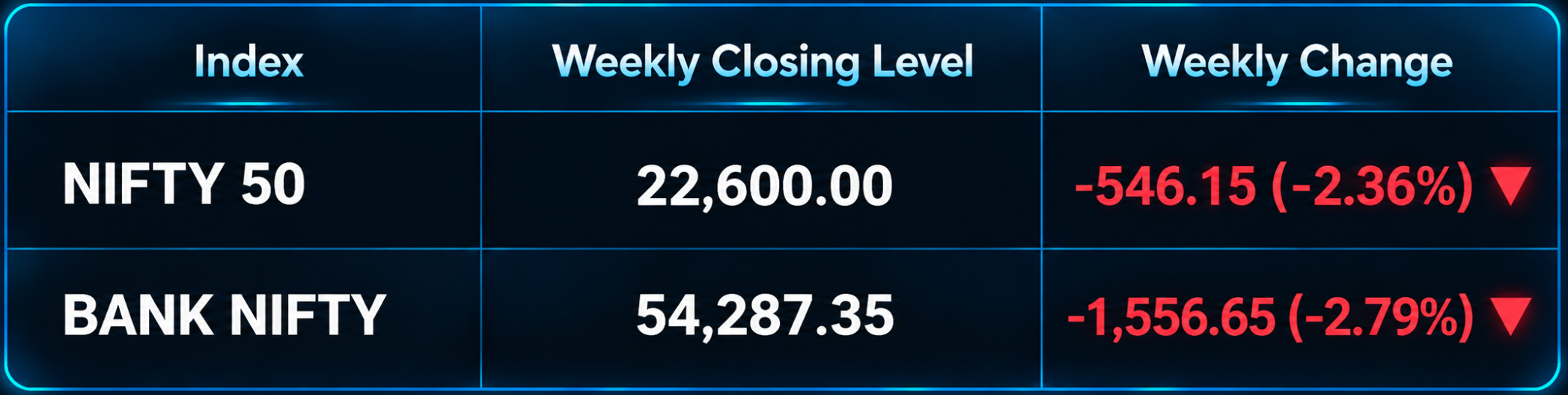
Indian equity markets witnessed a sharp reversal during October 19–23, 2026, surrendering much of the previous week's recovery as surging crude oil prices, escalating Middle East tensions, disappointing banking earnings and weak global cues weighed on investor sentiment. The Nifty 50 declined 546.15 points (-2.36%) to close at 22,600.00, while the Sensex dropped 1,605.44 points (-2.15%) to settle at 73,123.83. Bank Nifty recorded an even steeper correction, falling 1,556.65 points (-2.79%) to finish at 54,287.35.
The decline marked a significant setback following the strongest weekly rally in six months recorded during October 12–16. Selling pressure intensified across financial services, energy, automobiles, consumer-oriented businesses and other heavyweight sectors. Although select IT stocks demonstrated relative resilience, the broader market struggled to sustain buying interest amid growing concerns over inflation and corporate profitability.
The weakness extended beyond large-cap indices. Mid-cap and small-cap stocks faced particularly heavy selling, with weekly declines of approximately 5.6% and 7.3%, respectively. Fifteen of the 16 major sectors recorded weekly losses, reflecting widespread risk aversion and a deterioration in overall market breadth.
Crude oil remained the dominant macroeconomic concern, with Brent trading around $115.74 per barrel in the supplied market snapshot. Meanwhile, India VIX rose to 16.86, indicating increased expectations of near-term market volatility.
The upcoming week, October 26–30, 2026, will be crucial in determining whether Nifty can defend the 22,500–22,350 support region or extend its decline towards 22,200. Investors will closely monitor the US Federal Reserve's October 27–28 policy meeting, Q2 FY27 corporate earnings, geopolitical developments, crude oil prices, institutional flows and movements in the Indian rupee.
Weekly Market Review.
Market Summary: Sensex & Nifty 50 Performance
Monday, October 19: Indian markets began the week under significant selling pressure, snapping the previous two sessions' recovery. Nifty declined 257.20 points (-1.11%) to close at 22,888.95, while Sensex dropped approximately 876 points (-1.17%). Weak banking earnings, selling in private financial institutions, elevated crude oil prices and global uncertainty triggered widespread profit booking. Bank Nifty slipped to around 55,488 as investors reassessed near-term earnings expectations.
Tuesday, October 20: Indian stock exchanges remained closed for Dussehra. No regular equity trading took place on NSE or BSE.
Wednesday, October 21: Market volatility remained elevated as benchmarks failed to sustain early gains. Nifty declined approximately 0.34% to 22,811.35, while Sensex finished around 73,710, marginally lower. Brent crude climbed towards $111 per barrel, renewing concerns over inflation and corporate margins. IT stocks offered selective support, with Infosys, HCLTech, Tech Mahindra and TCS attracting buying interest, but weakness in financial services and other cyclical sectors limited the recovery.
Thursday, October 22: Indian equities extended their decline for a third consecutive session as crude oil surged beyond $112 per barrel amid escalating geopolitical tensions. Nifty fell 123.70 points (-0.54%) to close at 22,687.65, while Sensex lost 460.30 points (-0.62%) to settle at 73,249.39. Selling in FMCG, IT, energy and major heavyweight stocks weighed on sentiment, while small-cap and mid-cap shares also remained under pressure.
Friday, October 23: Benchmarks ended another volatile session in negative territory despite recovering from intraday lows. Nifty declined 87.65 points (-0.39%) to finish at 22,600.00, while Sensex dropped 125.56 points (-0.17%) to settle at 73,123.83. Bank Nifty declined 638.35 points (-1.16%) to 54,287.35. Metal stocks led the day's sectoral losses, followed by consumer durables and realty. The Nifty Midcap 100 fell approximately 2.21%, while the Nifty Smallcap 100 lost 2.94%, highlighting continued stress in broader markets.
Share Market Live News: The Big Macro Triggers This Week
1. Nifty Falls 2.36% as Previous Week's Recovery Unravels
Indian equities reversed sharply after the strong rebound recorded during October 12–16. The Nifty fell from 23,146.15 to 22,600.00, while Sensex dropped from 74,729.27 to 73,123.83, reflecting a deterioration in short-term sentiment.
Nifty traded between a weekly high of 23,175.25 and a low of 22,372.00, indicating substantial intraweek volatility. The index briefly attempted to sustain the previous week's recovery but failed to attract consistent buying interest at higher levels.
The decline below 23,000, followed by a breakdown beneath 22,800 and 22,700, weakened the short-term technical structure. Bank Nifty's sharper 2.79% fall reinforced the pressure on benchmark indices, particularly as financial stocks remain important contributors to index movements.
Broader market weakness was even more pronounced. Small-cap and mid-cap indices registered their steepest weekly declines in approximately 20 months, suggesting that risk aversion was not limited to heavyweight stocks.
The 22,500–22,350 region has now emerged as an important near-term support area, while 22,800–23,000 represents a significant recovery zone. Failure to defend immediate support could expose the index to additional selling pressure.
2. Brent Crude Above $115 Becomes the Biggest Market Concern
Rising crude oil prices emerged as one of the most important drivers of market weakness during the week.
Escalating Middle East tensions and concerns over potential supply disruptions pushed Brent crude sharply higher. Reports of attacks affecting Saudi Arabian energy infrastructure further intensified concerns surrounding global oil supplies.
The supplied Friday market dashboard showed Brent crude at approximately $115.74 per barrel, highlighting the extent of the recent increase.
For India, higher crude oil prices present multiple economic challenges. They can increase the country's energy import bill, place downward pressure on the rupee, raise transportation and manufacturing costs and complicate the inflation outlook.
Oil-sensitive industries such as Aviation, Paints, Chemicals, FMCG and Oil Marketing Companies remain particularly vulnerable to sustained increases in energy costs.
A decline in Brent towards $110–112 could provide some relief to domestic equities, while another sustained move beyond $116–118 may intensify concerns over inflation and corporate operating margins.
3. Banking Stocks Face Pressure Following Disappointing Earnings
Financial services emerged as a major source of weakness during the week, with Bank Nifty declining 2.79% to 54,287.35.
Investor sentiment weakened following disappointing earnings and renewed concerns surrounding loan growth, net interest margins, funding costs and credit quality.
HDFC Bank declined approximately 5% during the week, while Axis Bank lost around 5.6% and Bajaj Finance fell approximately 5.4%, according to the week's market reporting.
The correction reflected increased uncertainty about the banking sector's ability to sustain earnings growth amid elevated interest rates and rising inflation risks.
Although selective buying emerged in some banking counters, the sector remained vulnerable as institutional investors reassessed earnings expectations.
Bank Nifty now faces an important technical challenge around 54,700–55,000. A sustained recovery above this region could help stabilise sentiment, while further weakness below 54,000 may increase downside pressure.
4. Jio Platforms IPO Draws Liquidity as Investors Turn Cautious
The $3.2 billion Jio Platforms IPO became another major development during the week, attracting significant investor attention.
The offering reportedly received subscriptions equivalent to approximately 13.8 times the shares available, reflecting substantial demand for the public issue.
However, the scale of the IPO also raised questions about near-term liquidity available for the secondary market. Large public offerings can temporarily absorb investor capital and influence short-term participation in listed equities.
The effect became particularly relevant during a period when global uncertainty, rising crude oil prices and weak institutional sentiment were already affecting market confidence.
Investors will monitor the completion of the IPO process, subsequent capital allocation decisions and the potential implications for the broader telecom and digital services sectors.
While strong subscription levels suggest investor appetite for major offerings, the secondary market's weakness highlights the importance of distinguishing demand for individual opportunities from overall market sentiment.
5. India VIX Rises as Market Volatility Intensifies
India VIX rose to 16.86 in the supplied Friday snapshot, registering a daily increase of approximately 6.96%.
The increase indicates that market participants are pricing in greater near-term volatility following the sharp correction across benchmarks and broader indices.
Friday's sector performance reinforced the weak market environment:
Sector | Friday's Change |
|---|---|
IT | -0.27% |
Auto | -0.60% |
FMCG | -0.99% |
Financial Services | -1.03% |
Pharma | -1.04% |
Energy | -1.66% |
Realty | -2.38% |
Consumer Durables | -2.63% |
Metal | -2.71% |
Source: Supplied sector heatmap for Friday, October 23, 2026. These figures represent one-day changes, not weekly sector returns.
IT remained relatively resilient compared with other major sectors, while Metal, Consumer Durables and Realty faced substantial selling pressure.
The broad-based decline suggests that investors remain cautious about taking fresh exposure to economically sensitive sectors. The rise in India VIX also highlights the need for disciplined position sizing and risk management, particularly in leveraged and derivatives-based strategies.
Top Nifty Gainers & Losers Last Week
Top Gainers (1-Week Performance)
HCL TECHNOLOGIES (HCLTECH): +3.06% | ₹1,422.20
HCLTech emerged as the strongest performer among the highlighted Nifty 50 gainers, advancing 3.06% despite the benchmark's significant weekly decline.
The stock benefited from relative strength across select IT companies, as investors continued to assess Q2 FY27 earnings, deal activity and opportunities associated with artificial intelligence and digital transformation.
Its ability to deliver positive weekly returns during a broad market correction reflected stronger relative performance. However, continued upside will depend on sustaining buying momentum amid a challenging global environment.
TATA CONSULTANCY SERVICES (TCS): +2.64% | ₹2,530.00
TCS gained 2.64% during the week, extending its relative outperformance following the previous week's strong rally in technology stocks.
Investor interest in established IT businesses, earnings visibility and potential demand for AI-related technology services helped the stock remain comparatively resilient.
The weekly advance stood out against Nifty's 2.36% decline. However, investors should monitor whether the stock can maintain its strength if broader technology markets face renewed selling pressure.
OIL AND NATURAL GAS CORPORATION (ONGC): +2.48% | ₹227.50
ONGC advanced 2.48%, benefiting from investor attention towards upstream energy producers during a period of sharply rising crude oil prices.
Higher international crude prices can support revenue realisations for oil exploration and production companies, although the ultimate earnings impact depends on production volumes, government policies and realised prices.
With Brent crude trading above $115 in the supplied snapshot, ONGC remains an important stock to monitor for further developments in energy markets.
Top Losers (1-Week Performance)
ADANI ENTERPRISES (ADANIENT): -7.99% | ₹2,477.00
Adani Enterprises emerged as the weakest performer among the highlighted Nifty 50 stocks, declining 7.99% during the week.
The sharp correction reflected substantial selling pressure in the stock amid weak broader market sentiment and reduced appetite for volatile, growth-oriented businesses.
Investors will monitor upcoming quarterly earnings, operational developments and whether the stock can stabilise following its significant weekly decline.
SHRIRAM FINANCE (SHRIRAMFIN): -7.97% | ₹865.00
Shriram Finance declined 7.97%, significantly underperforming the Nifty and reflecting widespread weakness across financial services.
Investor concerns surrounding funding costs, interest-rate expectations, credit quality and economic uncertainty continued to influence sentiment towards lending businesses.
The stock's steep decline highlights the importance of monitoring upcoming earnings commentary, asset quality trends and management guidance before assessing a potential recovery.
TRENT (TRENT): -7.81% | ₹2,727.50
Trent lost 7.81% during the week, reflecting sustained selling pressure in consumer-focused and retail businesses.
Elevated valuations, concerns over discretionary consumption and increasing input costs may continue to affect investor appetite for premium retail companies.
The stock's weakness was consistent with broader pressure across consumer-oriented sectors. Investors will closely monitor earnings growth, store expansion, margins and consumption trends to evaluate its near-term outlook.
Institutional Activity: FIIs vs. DIIs
Institutional flows remained mixed during the week of 19–23 October 2026, with FII selling being strongly offset by sustained DII buying. Foreign Institutional Investors (FIIs) recorded cumulative net outflows of approximately ₹2,697.37 crore across four trading sessions. The highest FII selling was witnessed on Thursday, 22 October, at ₹3,458.70 crore, followed by Monday at ₹1,148.64 crore. However, FIIs turned net buyers on Wednesday and Friday, recording inflows of ₹1,022.32 crore and ₹887.65 crore, respectively, indicating selective recovery in foreign institutional participation.
Domestic Institutional Investors (DIIs) maintained strong buying momentum throughout the week, registering cumulative net inflows of approximately ₹10,942.19 crore. The highest DII buying was recorded on Friday, 23 October, at ₹3,235.36 crore, followed by Monday at ₹3,201.19 crore and Thursday at ₹2,891.32 crore. DIIs remained net buyers across all four trading sessions, demonstrating sustained domestic institutional support and helping absorb foreign selling pressure, thereby providing stability to the broader market.
Market Outlook & Nifty Prediction for October 26–30, 2026
The Nifty enters the upcoming week at 22,600.00, following a 2.36% weekly decline that erased a substantial portion of the previous week's gains.
The index traded between 22,372.00 and 23,175.25 during October 19–23, reflecting elevated volatility and repeated selling pressure at higher levels.
The inability to sustain above 23,000, followed by the decline towards 22,600, suggests that short-term sentiment has turned cautious to bearish.
With India VIX at 16.86 and Brent crude near $115.74 per barrel, the market may remain sensitive to global headlines, oil-price movements, US monetary policy developments and corporate earnings.
A sustained recovery above 22,800–22,950 would be an important initial indication of improving buying interest. A stronger breakout above 23,000–23,200 could help revive the recovery towards 23,400.
Conversely, a breakdown below 22,500 could renew selling pressure towards the week's low around 22,372, followed by 22,200–22,000.
Indicative Nifty Range: 22,000–23,200
Nifty 50 Levels | Range |
|---|---|
Immediate Support | 22,550–22,500 |
Secondary Support | 22,400–22,350 |
Major Support | 22,200–22,000 |
Immediate Resistance | 22,800–22,950 |
Recovery Zone | 23,000–23,200 |
Major Resistance | 23,300–23,500 |
Indicative technical monitoring zones derived from the supplied weekly price range and recent market structure; these are not guaranteed turning points.
The 22,500 level will be particularly important during the opening sessions of the new week. Sustained buying around this support could encourage a technical recovery, while continued weakness may signal a deeper correction.
Bank Nifty Outlook
Bank Nifty closed at 54,287.35, declining 2.79% during the week and underperforming both Nifty and Sensex.
The index recorded a weekly high of 55,883.70 and a low of 53,942.35, reflecting considerable selling pressure in banking and financial stocks.
Weakness in heavyweight private banks and concerns surrounding earnings quality, interest-rate expectations and credit growth continued to influence the sector.
Bank Nifty needs to reclaim 54,700–55,000 to improve near-term sentiment. A sustained breakout could encourage a recovery towards 55,500–55,900.
Conversely, a breakdown below 54,000 could trigger additional weakness towards 53,700–53,500.
Bank Nifty Levels | Range |
|---|---|
Immediate Support | 54,000–53,900 |
Major Support | 53,700–53,500 |
Immediate Resistance | 54,700–55,000 |
Major Resistance | 55,500–55,900 |
Banking stocks will remain particularly important during the upcoming week because of their substantial weight in benchmark indices. Any improvement in Bank Nifty could provide support to the broader market, while continued weakness may restrict recovery attempts.
Key Triggers for October 26–30
1. US Federal Reserve Policy Meeting: The Federal Reserve's scheduled October 27–28 meeting will be one of the most important global events. Investors will monitor the interest-rate decision, inflation commentary and future policy guidance for implications for emerging-market capital flows.
2. Q2 FY27 Corporate Earnings: Quarterly results will remain a significant driver of stock-specific volatility. Earnings announcements and management guidance across automobiles, pharmaceuticals, financial services, infrastructure and consumer businesses could influence sector performance.
3. Crude Oil & Middle East Tensions: Brent crude near $115.74 remains a significant concern for India's inflation outlook and corporate profitability. Any escalation in geopolitical tensions or supply disruptions could intensify selling pressure.
4. FII/DII Activity & Rupee: Foreign portfolio flows, domestic institutional support and currency movements will remain important indicators of market liquidity and investor confidence. The supplied USD/INR snapshot stands at 94.94.
5. Banking Sector Performance: Following Bank Nifty's 2.79% weekly decline, investors will monitor whether financial stocks stabilise. Banking heavyweights may play a decisive role in determining the direction of the Nifty.
6. IT Sector Resilience: HCLTech and TCS registered positive weekly returns despite broad market weakness. Investors will assess whether selective buying in IT stocks can continue amid global technology spending concerns.
7. Technical Levels: Nifty must defend the 22,500–22,350 support zone and reclaim 22,800–23,000 to improve its near-term outlook. A sustained break below 22,350 could intensify bearish momentum.
8. Market Volatility: India VIX at 16.86 indicates elevated volatility expectations. Traders should remain prepared for sharp intraday movements, particularly around major earnings announcements and the Federal Reserve decision.
Market Holiday: NSE's published 2026 equity holiday calendar lists no scheduled trading holiday during October 26–30. The upcoming week therefore contains five scheduled regular trading sessions.
Strategy
Maintain a cautious approach while Nifty trades below 22,800–23,000. A sustained recovery above this resistance region could encourage short-covering and renewed buying interest towards 23,200–23,400.
Conversely, a sustained breakdown below 22,500 could expose the index to renewed selling pressure towards 22,350 and 22,200.
Traders should avoid aggressive leveraged positions during periods of elevated volatility, particularly ahead of the Federal Reserve policy announcement.
Selective opportunities may emerge in fundamentally strong IT companies, upstream energy producers and quality large-cap businesses. However, new positions should ideally be supported by improving price action, stable market breadth and clearly defined risk management.
Stocks to Watch & Best Investment Opportunities for October 26–30, 2026
Based on the latest corporate announcements, official investor disclosures, Q2 FY27 earnings and long-term business prospects, the following five stocks stand out as investment candidates for the upcoming week. The selection prioritises business fundamentals, earnings visibility, financial strength and long-term growth potential rather than recent weekly gainers or losers.
1. Tata Consultancy Services (TCS)
Sector: Information Technology | Investment Horizon: Medium to Long Term
TCS remains an investment candidate following its Q2 FY27 results, which demonstrated operating stability and continued expansion in artificial intelligence-related services.
The company reported quarterly revenue of $7.64 billion, representing 2.4% year-on-year growth in US dollar terms. Its operating margin stood at 24%, while total contract value reached $9.6 billion.
Annualised AI revenue crossed $3.1 billion, contributing more than 10% of overall revenue. The company also announced major strategic partnerships involving Porsche and Best Buy, strengthening its positioning in AI-led enterprise transformation.
TCS benefits from established global client relationships, strong cash generation and a diversified services portfolio. Nevertheless, slower discretionary technology spending and international economic uncertainty remain key risks.
Investment Outlook: TCS remains a relatively defensive large-cap IT investment candidate for the medium to long term. Investors may consider accumulating in phases during market corrections, subject to valuation comfort and continued earnings stability.
2. ICICI Bank Ltd (ICICIBANK)
Sector: Banking & Financial Services | Investment Horizon: Medium to Long Term
ICICI Bank emerges as a strong investment candidate following its Q2 FY27 earnings announcement on October 17, 2026, supported by robust profitability, healthy credit growth and improving asset quality.
The bank reported standalone net profit of ₹14,843 crore, representing growth of 20.1% year-on-year. Net interest income increased 17.7% to ₹25,339 crore, while core operating profit rose 21.8% to ₹20,805 crore, reflecting sustained business momentum and operational efficiency.
Total advances expanded 30% year-on-year to ₹18.32 lakh crore, while deposits grew 27.1% to ₹20.50 lakh crore. Asset quality strengthened, with gross NPA declining to 1.20% and net NPA improving to 0.30%, indicating effective credit risk management.
The bank maintained a strong capital adequacy ratio of 16.68%, providing financial flexibility for future expansion. However, net interest margin moderated to 4.18%, highlighting the need to monitor funding costs and lending profitability.
Investment Outlook: ICICI Bank offers attractive long-term exposure to India's banking sector, supported by consistent earnings growth, strong asset quality and healthy credit demand. Investors may consider gradual accumulation at reasonable valuations while monitoring margin pressures and credit growth sustainability.
3. Larsen & Toubro (LT)
Sector: Engineering & Infrastructure | Investment Horizon: Long Term
Larsen & Toubro remains an important investment candidate for exposure to India's infrastructure development, industrial capital expenditure and engineering opportunities.
The company's diversified operations across engineering, construction, infrastructure and technology services provide exposure to several long-term growth themes.
L&T has officially scheduled its Q2 and H1 FY27 earnings announcement and management conference call for October 27, 2026, making the stock particularly relevant during the upcoming week.
Investors should closely monitor fresh order inflows, execution performance, operating margins, working capital and management commentary on domestic and international projects.
While a strong order pipeline and infrastructure investment could support long-term earnings, project execution delays, elevated material costs and geopolitical uncertainties remain potential risks.
Investment Outlook: L&T remains a long-term infrastructure investment candidate. Investors may prefer reviewing the October 27 earnings announcement before making fresh allocations, particularly during the current volatile market environment.
4. Bharti Airtel (BHARTIARTL)
Sector: Telecommunications | Investment Horizon: Long Term
Bharti Airtel offers exposure to India's expanding mobile data consumption, digital connectivity and telecommunications infrastructure.
The company's business opportunities include mobile services, enterprise connectivity, broadband and data centres, providing multiple avenues for long-term expansion.
In March 2026, Bharti Airtel announced a $1 billion investment initiative for its Nxtra data centre business, supported by external investors and Airtel's participation. The transaction valued Nxtra at approximately $3.1 billion after the proposed investment.
The company also received shareholder approval in June 2026 for a strategic consolidation of its interests in Airtel Africa, supporting its longer-term international business strategy.
Growing data usage, potential improvements in customer monetisation and expansion of digital infrastructure remain important investment drivers.
However, capital expenditure requirements, competition, debt obligations and regulatory developments could influence profitability and valuations.
Investment Outlook: Bharti Airtel remains a long-term telecommunications investment candidate. Investors should evaluate cash-flow generation, leverage, average revenue per user and entry valuation before considering accumulation.
5. Hindustan Unilever (HINDUNILVR)
Sector: FMCG | Investment Horizon: Medium to Long Term
Hindustan Unilever remains an important stock to watch for investors seeking exposure to established consumer brands and relatively defensive business operations.
The company's March-quarter FY26 results showed consolidated revenue growth of 8% year-on-year, supported by underlying sales growth of 7% and underlying volume growth of 6%. Its EBITDA margin stood at 23.7%.
The performance demonstrated improvement in consumer demand and operating execution, although inflation and raw material costs remain ongoing considerations.
HUL has scheduled its September-quarter FY27 results for October 28, 2026. Investors will be watching volume growth, rural and urban demand trends, gross margins, pricing actions and management's outlook for consumer spending.
Elevated crude oil prices may increase packaging and transportation costs, potentially affecting operating margins across consumer businesses.
Investment Outlook: HUL remains a potential defensive long-term investment candidate. Investors should assess its October 28 earnings and valuation before deciding whether the recent broader-market correction offers a favourable entry opportunity.
Investment Outlook
Among the five selected stocks, TCS and Infosys provide exposure to established IT services businesses, with their latest earnings highlighting improving AI-related opportunities and substantial enterprise deal activity.
Larsen & Toubro offers long-term exposure to infrastructure development and capital expenditure, with its October 27 results expected to provide important insight into execution performance and the order pipeline.
Bharti Airtel offers exposure to expanding digital connectivity and telecommunications infrastructure, while Hindustan Unilever provides a more defensive consumer-business investment theme, with quarterly earnings scheduled for October 28.
For the week of October 26–30, 2026, investors should remain selective as Nifty trades near 22,600 following its sharp weekly correction. The Federal Reserve's policy decision, corporate earnings, rising crude oil prices and institutional flows may continue to influence market direction.
From a medium- to long-term perspective, these five companies merit further fundamental analysis. However, strong business fundamentals do not automatically imply attractive stock valuations. A definitive buy recommendation would require comparing current market prices with earnings estimates, valuation multiples, historical averages and the respective companies' growth outlooks.
Investors should favour staggered investments, valuation discipline and appropriate diversification rather than deploying substantial capital during periods of heightened volatility.
💡 Pro-Tip: Want a real-time technical analysis for these stocks? Ask LiMo, our AI co-pilot, for an instant buy/sell rating.
Discover Investment Opportunities with Liquide
Available on both Google Play Store and Apple Appstore, Liquide offers up-to-date market analysis, expert recommendations and real-time insights to guide your investment decisions.
Download the Liquide App today and enhance your financial journey.
Disclaimer: The information provided in this article is for informational and educational purposes only and does not constitute financial, investment or trading advice.
Stock, commodity and currency markets involve significant risk. Readers are strongly advised to consult with their financial advisors before making any investment decisions.
For a detailed Disclaimer, please visit our website https://liquide.life/