
Weekly Review & Indian Stock Market Prediction (Oct 12th – Oct 16th, 2026)
Nifty gained 0.44% WoW to 22,520.45, snapping its eight-week losing streak as IT and banking stocks led the recovery despite FII selling, elevated crude prices and global uncertainty. Full recap & outlook for October 12–16.


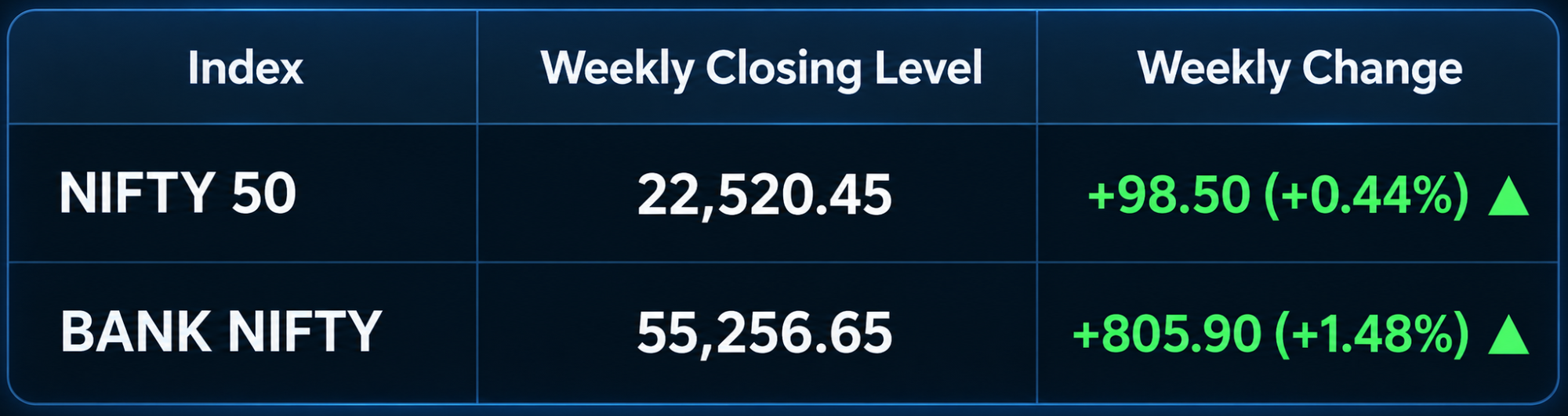
Indian equity markets ended a highly volatile but marginally positive week, with benchmark indices snapping their eight-week losing streak, the longest in approximately 25 years. The Nifty 50 gained 98.50 points (+0.44%) to close at 22,520.45, while the Sensex advanced 562.63 points (+0.78%) to settle at 72,472.33. The Bank Nifty outperformed, climbing 805.90 points (+1.48%) to finish at 55,256.65.
The Nifty traded between 22,179.90 and 22,776.10 during the week, reflecting sharp swings driven by the RBI's monetary policy announcement, elevated crude oil prices, rising global bond yields and persistent foreign institutional selling. Markets initially recovered, faced renewed pressure after the RBI raised interest rates, and rebounded strongly on Friday as buying in IT, FMCG and banking stocks supported sentiment. Friday's 1.30% Nifty rally helped the index reclaim the 22,500 mark and end the week in positive territory.
The upcoming week, October 12–16, 2026, is expected to remain eventful, with investors shifting their focus towards Q2 FY27 corporate earnings, domestic inflation indicators, crude oil movements and global interest-rate expectations. Following the RBI's decision to raise the repo rate by 25 basis points to 5.50%, investors will closely monitor the impact of tighter monetary conditions on banking, consumption and corporate profitability. IT earnings momentum, geopolitical developments and foreign investor flows will also remain important market triggers.
Weekly Market Review.
Market Summary: Sensex & Nifty 50 Performance
Monday, October 5: Indian markets began the week on a positive note, recovering from eight consecutive weeks of losses. The Nifty gained 133.80 points (+0.60%) to close at 22,555.75, while the Sensex climbed 472.77 points (+0.66%) to 72,382.47. Softer crude oil prices, easing concerns about aggressive U.S. monetary tightening and encouraging September-quarter business updates supported the recovery. Financial stocks led the gains, with Bajaj Finance, Punjab National Bank and other lenders attracting buying interest.
Tuesday, October 6: Markets extended their recovery for a second consecutive session, supported by positive global cues, relatively softer crude oil prices and strength in banking and select consumer-oriented stocks. The Nifty closed above 22,700, while the Sensex gained approximately 685 points. Trent emerged as a standout performer following encouraging business developments, while expectations surrounding the upcoming RBI policy decision kept trading selective.
Wednesday, October 7: The two-session recovery came to an end after the RBI raised its repo rate by 25 basis points to 5.50% and shifted its monetary policy stance to calibrated tightening. The Nifty declined 0.76%, while the Sensex fell 0.59%, as investors reassessed the impact of higher borrowing costs and inflation risks. Fourteen of the 16 major sectoral indices declined, with Auto, FMCG, Realty and Metal witnessing pressure. Banking stocks demonstrated relative resilience as the central bank refrained from additional liquidity tightening.
Thursday, October 8: Indian equities witnessed their sharpest sell-off of the week as surging crude oil prices, elevated U.S. Treasury yields, continued rupee weakness and aggressive FII selling weighed on sentiment. The Nifty declined 370.75 points (-1.64%) to 22,231.80, while the Sensex plunged 1,045.47 points (-1.44%) to 71,593.24. All 16 major sectoral indices ended lower, while broader-market indices also suffered significant losses.
Friday, October 9: Markets staged a strong recovery, snapping the previous session's sharp decline. The Nifty gained 288.65 points (+1.30%) to close at 22,520.45, while the Sensex surged 879.09 points (+1.23%) to 72,472.33. Bank Nifty rose 741.60 points (+1.36%) to 55,256.65, while India VIX declined 5.89% to 14.375. IT led sectoral gains, advancing 3.02%, followed by FMCG (+2.20%), Auto (+1.42%), Financial Services (+1.33%) and Metal (+1.10%). Strong buying in technology stocks following TCS earnings, along with some easing in geopolitical concerns, supported the rebound.
Share Market Live News: The Big Macro Triggers This Week
1. Nifty Snaps Eight-Week Losing Streak
After eight consecutive weeks of declines, Indian benchmarks finally registered weekly gains, offering some relief to investors.
The Nifty gained 0.44% to 22,520.45, while the Sensex advanced 0.78% to 72,472.33. Bank Nifty outperformed both benchmarks with a gain of 1.48%, reflecting comparatively stronger participation in financial stocks.
However, the recovery was far from smooth. The Nifty touched a weekly low of 22,179.90 and a high of 22,776.10, highlighting continued volatility and uncertainty.
Friday's strong rebound helped the index recover from Thursday's sell-off, but the broader structure remains sensitive to external developments.
The 22,200 zone has emerged as an important short-term support area, while 22,700–22,800 remains the immediate resistance region.
A sustained move above 22,800 could improve the short-term outlook, while a break below 22,200 may bring renewed selling pressure.
2. RBI Raises Repo Rate to 5.50%, Shifts to Tightening
The RBI's monetary policy decision was one of the most important domestic developments during the week.
On October 7, the Monetary Policy Committee unanimously increased the repo rate by 25 basis points from 5.25% to 5.50%, marking the first rate increase since February 2023.
The central bank also shifted its policy stance from neutral to calibrated tightening, signalling that controlling inflation has become an increasingly important priority.
The RBI additionally revised its FY27 GDP growth forecast to 7.1% from 6.7%, while increasing its inflation forecast to 5.2% from 5.0%.
Higher policy rates could increase borrowing costs for businesses and consumers, particularly affecting rate-sensitive sectors such as Auto, Realty and Consumer Durables. However, banking stocks may benefit from improved lending yields, depending on deposit costs and credit demand.
Next week, investors will closely examine incoming inflation data and banking-sector developments for indications of the RBI's future policy direction.
3. Crude Oil & Middle East Developments Remain Critical
Crude oil continued to be one of the biggest drivers of Indian equity markets.
Prices remained volatile throughout the week as supply risks and developments in the Middle East influenced investor sentiment.
Brent crude climbed above $105 per barrel during the week, adding to concerns over India's import bill, inflation and corporate profitability.
By Friday, Brent prices had moderated, with the supplied market snapshot showing $105.63 per barrel, down 1.19% for the session.
Elevated crude oil prices remain particularly important for India because of the country's dependence on imported energy.
A sustained decline in crude could support the rupee and provide relief to sectors such as Aviation, Paints, Chemicals and Oil Marketing Companies. Conversely, another sharp increase could renew inflation concerns and pressure domestic equities.
With geopolitical uncertainty continuing, crude oil developments will remain one of the biggest global triggers for October 12–16.
4. U.S. Treasury Yields and Rupee Weakness Add to Uncertainty
Elevated global bond yields continued to influence risk appetite during the week.
The U.S. 10-year Treasury yield climbed above 5.3%, reaching levels not seen since 2002, as investors reassessed inflation risks and the outlook for global monetary policy.
Higher bond yields increase the appeal of U.S. fixed-income assets and can put pressure on emerging-market capital flows, including investments into India.
Meanwhile, the Indian rupee remained under pressure, closing Friday near ₹96.73 per U.S. dollar, despite the RBI's interest-rate increase.
The combination of elevated crude oil prices, a relatively strong dollar and continued foreign outflows remains a challenge for Indian financial markets.
Investors will therefore closely monitor movements in U.S. yields, the dollar index and the rupee during the coming week.
5. India VIX Eases as IT & FMCG Lead Friday's Recovery
Market volatility increased sharply during the week before moderating during Friday's recovery.
India VIX ended October 9 at 14.375, declining 5.89% during the session, indicating some easing in near-term volatility expectations.
Friday's sector performance highlighted strong buying across several major sectors.
Sector | Friday's change |
|---|---|
IT | +3.02% |
FMCG | +2.20% |
Auto | +1.42% |
Financial Services | +1.33% |
Metal | +1.10% |
Consumer Durables | +1.00% |
Realty | +0.92% |
Pharma | +0.54% |
Energy | +0.38% |
IT emerged as the strongest sector during Friday's session, supported by optimism surrounding TCS earnings and improving demand visibility in selected technology businesses.
FMCG also witnessed strong buying, while banking and financial stocks participated in the broader recovery.
However, these figures represent Friday's performance, not cumulative weekly sector returns. Over the full week, financial services gained approximately 1.7% and IT around 1%, while eight of the 16 major sectors finished higher.
Top Nifty Gainers & Losers Last Week
Top Gainers (1-Week Performance)
TRENT: +13.11% | ₹2,918.20 Trent emerged as the strongest performer among the highlighted stocks, significantly outperforming broader indices. The rally was supported by encouraging business updates, improved revenue expectations and buying interest in consumer-focused businesses.
BSE: +7.92% | ₹3,287.20 BSE delivered strong weekly gains, showing significant relative strength amid broader market volatility. The sharp upward movement highlighted continued buying interest in capital-market-related stocks.
KOTAK MAHINDRA BANK: +5.41% | ₹441.00 Kotak Mahindra Bank maintained strong momentum during the week, benefiting from buying interest in private-sector banks. The stock significantly outperformed the Nifty as financial services remained comparatively resilient.
Top Losers (1-Week Performance)
ADANI ENTERPRISES: -6.48% | ₹2,634.40 Adani Enterprises emerged among the weakest performers during the week, declining sharply amid broader market uncertainty. Reports of potential institutional stake reductions added to selling pressure.
MAX HEALTHCARE: -6.07% | ₹883.80 Max Healthcare witnessed sustained selling pressure during the week, significantly underperforming the broader market. The stock remained among the major weekly losers despite Friday's market recovery.
JSW STEEL: -5.27% | ₹1,168.00 JSW Steel remained under pressure amid volatile global commodity prices and concerns surrounding industrial demand. The broader Metal sector faced selling pressure amid global economic uncertainty.
Institutional Activity: FIIs vs. DIIs
Institutional flows remained sharply divergent during the week of 5–9 October 2026, with persistent FII selling being effectively absorbed by strong DII buying. Foreign Institutional Investors (FIIs) recorded cumulative net outflows of approximately ₹30,294.29 crore across five trading sessions. The highest FII selling was witnessed on Thursday, 8 October, at ₹12,943.58 crore, followed by Wednesday at ₹6,121.37 crore and Monday at ₹4,699.14 crore. FIIs remained net sellers throughout all five sessions.
Domestic Institutional Investors (DIIs) maintained their strong buying momentum, registering total net inflows of approximately ₹30,313.48 crore during the week. The highest DII buying was recorded on Thursday at ₹10,703.11 crore, followed by Monday at ₹5,181.62 crore and Tuesday at ₹5,088.92 crore. DIIs remained consistent net buyers across all five trading sessions.
Overall, combined institutional flows stood at approximately ₹19.19 crore of net inflows, indicating that domestic institutional participation almost entirely offset aggressive foreign selling. Persistent FII outflows continued to pressure market sentiment, while sustained DII buying provided a crucial cushion against broader market weakness.
Market Outlook & Nifty Prediction for October 12–16, 2026
Nifty enters the upcoming week at 22,520.45, snapping its eight-week losing streak with a 0.44% weekly gain.
The index traded between 22,179.90 and 22,776.10, reflecting continued volatility. Friday's strong rebound from the 22,200 region suggests buying interest near lower levels, although resistance around 22,700–22,800 remains a key hurdle.
A sustained breakout above 22,800 could push Nifty towards 23,000–23,200, while a breakdown below 22,200 may trigger further weakness towards 22,000–21,800.
Expected Range: 22,000–23,200
Support:
- 22,350–22,200 (Immediate Support)
- 22,000 (Psychological Support)
- 21,800 (Major Support)
Resistance:
- 22,600–22,700 (Immediate Resistance)
- 22,776–22,800 (Breakout Zone)
- 23,000–23,200 (Major Resistance)
Bank Nifty:
Bank Nifty closed at 55,256.65, gaining 1.48% for the week. Immediate support lies at 55,000–54,800, followed by 54,400–54,300. Resistance is placed at 55,400–55,500, with a breakout potentially opening the way towards 55,800–56,000.
Key Triggers
(1) Q2 FY27 Earnings: Corporate results, particularly from IT, banking and consumption sectors, will influence market sentiment and sector-specific movements.
(2) Domestic Inflation & RBI Policy: Following the repo rate hike to 5.50%, inflation data will be crucial in shaping expectations of further monetary tightening.
(3) Crude Oil & Middle East Tensions: Brent crude above $100 per barrel remains a concern for inflation, corporate margins and India's import costs.
(4) Global Bond Yields: Elevated U.S. Treasury yields and global interest-rate expectations could continue influencing foreign investment flows.
(5) FII/DII Activity & Rupee: Persistent foreign selling, domestic institutional buying and rupee weakness will remain important liquidity indicators.
(6) IT Earnings Momentum: Following TCS results, investors will monitor AI demand, deal wins and management guidance across major IT companies.
(7) Technical Levels: Nifty must reclaim 22,800 for stronger recovery momentum, while 22,200 remains the key downside support.
Strategy: Maintain a selective approach while Nifty trades between 22,200 and 22,800. A sustained breakout above 22,800 could extend the recovery towards 23,000–23,200, while a breakdown below 22,200 may lead to further weakness.
Traders should avoid chasing sharp rallies and wait for confirmation around key levels. IT, FMCG and select banking stocks have shown relative strength, while high-beta and commodity-sensitive sectors remain vulnerable to volatility.
Stocks to Watch & Investment Opportunities
Five stocks showing strong fundamentals, earnings-driven momentum and potential investment opportunities for October 12–16, 2026:
TCS
TCS remains a key investment candidate following its Q2 FY27 results, with net profit rising 15% YoY to ₹13,884 crore and revenue increasing 11.2%. Its annualized AI revenue reached $3.1 billion, highlighting growing opportunities in artificial intelligence. Stable operating margins of 24% and improving international business momentum make TCS an important stock to watch, although slower underlying demand remains a concern.
INFOSYS
Infosys could attract buying interest as sentiment towards Indian IT stocks improves following TCS earnings. The stock participated in Friday's IT-sector recovery, supported by expectations of better AI-related opportunities and potential benefits from rupee depreciation. Investors will closely monitor upcoming earnings, large deal wins and management guidance for confirmation of sustained business growth.
KOTAK MAHINDRA BANK
Kotak Mahindra Bank gained 5.41% during the week to ₹441.00, significantly outperforming the broader market. The stock demonstrated strong relative momentum as banking shares benefited from renewed investor interest. Following the RBI's rate hike, lending margins, deposit costs and credit growth will be important factors to monitor.
TRENT
Trent emerged as one of the strongest performers, gaining 13.11% during the week to ₹2,918.20. Encouraging business updates and positive expectations surrounding retail growth supported the rally. The company's growth prospects remain attractive, although the sharp recent appreciation makes valuation and the sustainability of buying momentum important considerations.
JSW STEEL
JSW Steel declined 5.27% during the week to ₹1,168.00, presenting a potential recovery candidate for investors tracking cyclical stocks. The company reported 5% YoY growth in Q2 crude steel production to 7.27 million tones, reflecting improving operating volumes. However, global steel demand, commodity prices and broader market sentiment remain key risks.
Investment Outlook: Among these five, TCS, Infosys and Kotak Mahindra Bank offer relatively stronger near-term investment cases based on the available earnings developments and market momentum. Trent warrants caution after its sharp rally, while JSW Steel is better viewed as a higher-risk recovery opportunity. Fresh entries should be evaluated against valuations, price confirmation and investment horizon rather than weekly performance alone.
💡 Pro-Tip: Want a real-time technical analysis for these stocks? Ask LiMo, our AI co-pilot, for an instant buy/sell rating.
Discover Investment Opportunities with Liquide
Available on both Google Play Store and Apple Appstore, Liquide offers up-to-date market analysis, expert recommendations and real-time insights to guide your investment decisions.
Download the Liquide App today and enhance your financial journey.
Disclaimer: The information provided in this article is for informational and educational purposes only and does not constitute financial, investment or trading advice.
Stock, commodity and currency markets involve significant risk. Readers are strongly advised to consult with their financial advisors before making any investment decisions.
For a detailed Disclaimer, please visit our website https://liquide.life/