
Weekly Review & Indian Stock Market Prediction (Nov 30th – Dec 4th, 2026)
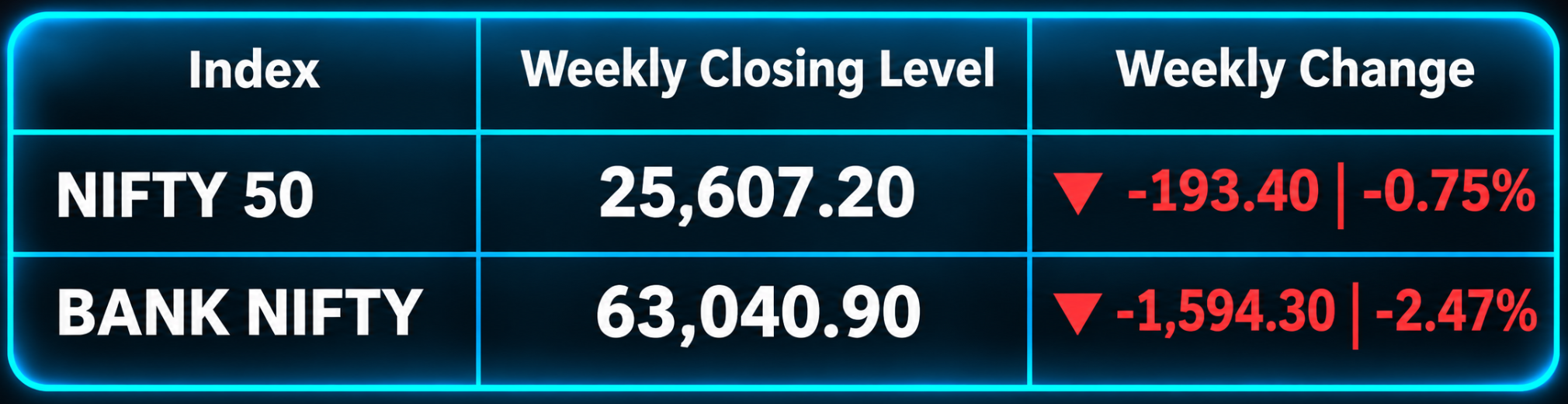
Nifty fell 0.75% WoW to 25,607, while Sensex declined 0.69% and Bank Nifty slipped 2.47%, weighed down by selling in banking and financial stocks. Full recap & outlook for November 30–December 4.


Indian equity markets ended the week of November 23–27, 2026, on a negative note, reversing part of their previous week's strong gains as selling pressure in Banking, Financial Services, Auto and Realty stocks weighed on benchmark indices. Despite selective buying in IT stocks during the week, the broader market witnessed weakness, with Bank Nifty significantly underperforming Nifty and Sensex.
The Nifty 50 declined 0.75% to close at 25,607.20, losing 193.40 points during the week. The Sensex fell 0.69% to 83,339.26, shedding 580.45 points, while Bank Nifty emerged as the weakest benchmark, declining 2.47% to 63,040.90, a weekly loss of 1,594.30 points.
Friday, November 27, witnessed particularly strong selling pressure. Nifty declined 277.30 points (-1.07%), Sensex plunged 989.33 points (-1.17%), and Bank Nifty slipped 494.40 points (-0.78%). IT (-1.88%), Auto (-1.48%), Realty (-1.43%) and Financial Services (-1.33%) led the sectoral decline, while Metal, Consumer Durables and Energy stocks demonstrated resilience.
Meanwhile, India VIX declined 1.72% on Friday to 16.5450, indicating a moderation in expected near-term market volatility despite the sharp market correction. Brent crude traded around $95.40 per barrel, while gold surged to approximately $3,668.44 per ounce. The USD/INR exchange rate advanced to 92.98, reflecting renewed weakness in the Indian rupee against the US dollar.
The upcoming week, November 30–December 4, 2026, will be important in determining whether Nifty can defend the 25,300–25,500 support zone and recover towards the psychological 26,000 level. Investors will closely monitor institutional activity, global market developments, US tariff proposals, crude oil prices, currency movements and the performance of banking and financial stocks.
Weekly Market Review.
Market Summary: Sensex & Nifty 50 Performance
Bank Nifty emerged as the weakest benchmark during the week, declining 2.47% amid selling pressure in banking and financial stocks. Nifty and Sensex also registered weekly losses, reversing part of their previous week's recovery.
Share Market Live News: The Big Macro Triggers This Week
1. Bank Nifty Falls 2.47% as Banking and Financial Stocks Witness Selling Pressure
Bank Nifty recorded a weekly decline of 2.47%, significantly underperforming Nifty's 0.75% decline and Sensex's 0.69% fall.
The banking index lost 1,594.30 points during the week to close at 63,040.90, reversing part of its previous week's sharp rally.
Axis Bank declined 4.56% during the week, while Shriram Finance fell 4.99%, reflecting weakness in major banking and financial services counters.
Financial Services declined 1.33% on Friday, contributing to the broader market correction.
The recent decline indicates weakening short-term momentum in banking stocks. However, a recovery above 63,500–64,000 could improve sentiment, while a breakdown below 62,500 may trigger further selling towards 62,000–61,500.
2. US Proposes Fresh Tariffs of Up to 25% on Indian Imports
The United States proposed fresh tariffs of up to 25% on Indian imports during the week, raising concerns regarding export competitiveness and global trade.
Under the proposed framework, tariffs on Indian goods could be capped at 17% if India and the United States reach a trade agreement.
Commerce Minister Piyush Goyal indicated on Friday that negotiations were nearing completion, offering some optimism regarding a potential agreement.
Higher tariffs could increase export costs, pressure corporate profit margins and affect the global competitiveness of Indian businesses.
Export-oriented sectors, including Textiles, Engineering, Chemicals, Pharmaceuticals and Auto Components, could remain sensitive to further developments.
Investors will closely monitor negotiations between India and the United States, particularly regarding final tariff rates, product coverage and implementation timelines.
3. IT, Auto and Realty Lead Friday's Sectoral Decline
Friday's sectoral heatmap reflected broad-based selling pressure, with IT, Auto, Realty and Financial Services emerging as the weakest major sectors.
Sector | Friday Change |
|---|---|
Metal | +1.40% |
Consumer Durables | +0.26% |
Energy | +0.15% |
Pharma | -0.40% |
FMCG | -0.93% |
Financial Services | -1.33% |
Realty | -1.43% |
Auto | -1.48% |
IT | -1.88% |
IT emerged as the weakest major sector on Friday, declining 1.88% despite strong weekly gains in leading technology stocks such as TCS, HCL Technologies and Infosys.
Auto declined 1.48%, followed by Realty (-1.43%) and Financial Services (-1.33%), reflecting weakness across major cyclical and rate-sensitive sectors.
FMCG declined 0.93%, while Pharma registered a relatively moderate decline of 0.40%.
On the positive side, Metal emerged as the strongest sector, advancing 1.40%, while Consumer Durables (+0.26%) and Energy (+0.15%) registered marginal gains.
The sectoral performance indicates that buying interest remained concentrated in select pockets of the market, while selling pressure dominated most major sectors.
4. Crude Oil Rises Above $95 as Rupee Weakens and Gold Surges
Crude oil prices remained elevated, raising concerns regarding India's energy import bill, inflation and corporate operating costs.
Based on Friday's market snapshot:
Indicator | Latest Value | Daily Change |
|---|---|---|
Brent Crude | $95.395 | +0.33% |
USD/INR | 92.9800 | +0.59% |
Gold (XAU/USD) | $3,668.44 | +2.86% |
Brent crude advanced 0.33% to approximately $95.40 per barrel, compared with $92.92 in the previous week's snapshot.
Elevated crude oil prices could increase India's import expenditure and pressure the profitability of oil-dependent industries, including Aviation, Paints, Chemicals and Oil Marketing Companies.
The USD/INR pair advanced 0.59% to 92.98, reflecting depreciation of the Indian rupee against the US dollar. Continued currency weakness could increase imported inflation and influence foreign institutional investment flows.
Gold surged 2.86% to approximately $3,668.44 per ounce. The sharp increase could reflect heightened demand for safe-haven assets amid uncertainty surrounding global trade, inflation and monetary policy.
Further increases in crude oil prices or weakness in the rupee could create additional challenges for Indian equities. Conversely, stabilisation in commodity prices and currency markets may support investor sentiment.
5. India VIX Declines 1.72% Despite Sharp Market Correction
India VIX declined 1.72% on Friday to close at 16.5450, decreasing by 0.2900 points.
Compared with the previous week's closing level of 17.3200, volatility has moderated, suggesting that expectations of near-term market fluctuations have eased.
However, the decline in India VIX does not necessarily indicate a reversal of the prevailing bearish momentum.
With uncertainty surrounding US tariffs, elevated crude oil prices, currency depreciation and upcoming monetary policy developments, investors should continue to monitor volatility closely.
A renewed increase in India VIX alongside weakness in benchmark indices could indicate heightened risk aversion, while sustained moderation may support market stabilisation.
Top Nifty Gainers & Losers Last Week
Top Gainers (1-Week Performance)
1. Tata Consultancy Services Ltd (TCS)
Information Technology
+8.26%
₹2,572.50
TCS emerged as the strongest weekly gainer among the highlighted stocks, reflecting strong buying interest in the technology major. Investors will monitor global IT spending, large deal wins, revenue growth and operating margins for signs of sustained momentum.
2. HCL Technologies Ltd (HCLTECH)
Information Technology
+5.93%
₹1,424.10
HCL Technologies advanced 5.93% during the week. Its enterprise technology services, cloud infrastructure, engineering capabilities and software business remain important factors influencing its growth outlook.
3. Infosys Ltd (INFY)
Information Technology
+4.85%
₹1,151.30
Infosys gained 4.85%, supported by buying interest in major technology counters. Global discretionary technology spending, artificial intelligence adoption, deal conversions and management commentary will remain important indicators.
Top Losers (1-Week Performance)
1. Tata Steel Ltd (TATASTEEL)
Metal & Steel
-7.90%
₹163.94
Tata Steel registered the steepest weekly decline among the highlighted stocks, despite a recovery in the Metal sector on Friday. Global steel demand, commodity prices, raw material costs and Chinese industrial activity remain important factors influencing the company's outlook.
2. Shriram Finance Ltd (SHRIRAMFIN)
Financial Services
-4.99%
₹923.50
Shriram Finance declined 4.99%, reflecting weakness in financial services stocks. Investors will monitor lending growth, borrowing costs, asset quality and net interest margins for indications of business performance.
3. Axis Bank Ltd (AXISBANK)
Banking & Financial Services
-4.56%
₹1,380.10
Axis Bank fell 4.56%, reversing part of its previous week's strong gains. Loan growth, deposit mobilisation, asset quality, funding costs and profitability will remain important indicators influencing the bank's outlook.
Institutional Activity: FIIs vs. DIIs
Institutional flows remained strongly positive during the week of 23–27 November 2026, with both Foreign Institutional Investors (FIIs) and Domestic Institutional Investors (DIIs) recording net inflows. FIIs registered cumulative net inflows of approximately ₹17,629.73 crore across four trading sessions. The highest FII buying was witnessed on Thursday, 26 November, at ₹5,843.33 crore, followed by Monday, 23 November, at ₹5,672.99 crore. FIIs remained net buyers throughout the week, reflecting sustained foreign institutional interest in Indian equities despite market volatility.
Domestic Institutional Investors (DIIs), meanwhile, registered cumulative net inflows of approximately ₹6,332.90 crore, reversing the selling trend witnessed in the previous week. The highest DII buying was recorded on Thursday, 26 November, at ₹5,630.72 crore, followed by Wednesday, 25 November, at ₹4,018.72 crore. However, DIIs remained net sellers on Monday and Friday, recording outflows of ₹2,760.12 crore and ₹556.42 crore, respectively. Overall, combined institutional net inflows of approximately ₹23,962.63 crore reflected positive institutional sentiment, with sustained foreign buying and renewed domestic participation providing underlying support to the broader market despite intermittent selling pressure.
Market Outlook & Nifty Prediction for November 30–December 4, 2026
Nifty enters the upcoming week at 25,607.20 after declining 0.75% during November 23–27. The index reached a weekly high of 25,992.60 and a low of 25,343.85, reflecting increased selling pressure near the psychological 26,000 resistance level.
The index failed to sustain its recent recovery and witnessed a sharp correction during Friday's session, bringing it closer to the important 25,500 support zone.
The broader short-term trend has turned cautious, with weakness in banking and financial stocks, elevated crude oil prices, currency depreciation and uncertainty surrounding US tariff proposals weighing on investor sentiment.
A sustained move above 25,800–26,000 could encourage recovery towards 26,150–26,300. Conversely, a breakdown below 25,300 could trigger further selling towards 25,150–25,000.
Indicative Nifty Range: 25,000–26,300
Nifty 50 Technical Levels
Nifty 50 Levels | Range |
|---|---|
Immediate Support | 25,500–25,350 |
Secondary Support | 25,200–25,000 |
Major Support | 24,800–24,600 |
Immediate Resistance | 25,800–26,000 |
Recovery / Breakout Zone | 26,100–26,150 |
Major Resistance | 26,200–26,300 |
Indicative Nifty 50 Trading Zones
Illustrative technical zones based on the supplied weekly price action, not guaranteed price targets.
The 25,500–25,350 zone remains important for preventing further deterioration in market sentiment, while a decisive breakout above 26,000 could support a recovery towards 26,200–26,300.
However, failure to defend immediate support levels could result in further downside, particularly if banking and financial stocks continue to witness selling pressure.
Bank Nifty Outlook
Bank Nifty closed at 63,040.90, declining 2.47% during the week and significantly underperforming Nifty and Sensex.
The index recorded a weekly high of 65,193.40 and a low of 62,546.20, reflecting substantial selling pressure after failing to sustain above the psychological 65,000 level.
The sharp weekly decline indicates weakening short-term momentum in banking stocks. However, a sustained recovery above immediate resistance levels could support a technical rebound.
A sustained move above 63,500–64,000 could encourage further recovery towards 64,500–65,000. On the downside, 62,500–62,000 remains an important initial support area.
Bank Nifty Technical Levels
Bank Nifty Levels | Range |
|---|---|
Immediate Support | 62,500–62,000 |
Secondary Support | 61,500–61,000 |
Major Support | 60,500–60,000 |
Immediate Resistance | 63,500–64,000 |
Recovery / Breakout Zone | 64,500–65,000 |
Major Resistance | 65,200–65,500 |
Banking stocks are likely to remain crucial in determining whether Nifty can recover during the upcoming week.
Renewed buying in private-sector banks and financial services companies may support broader benchmarks, while continued weakness in heavyweight banking stocks could limit recovery.
Key Triggers for November 30–December 4
1. RBI Monetary Policy Meeting: The Reserve Bank of India's Monetary Policy Committee is scheduled to meet from December 2–4, 2026. Investors will closely monitor interest-rate decisions, inflation projections, liquidity measures and the RBI's commentary on economic growth.
2. India-US Trade Negotiations: Proposed US tariffs of up to 25% on Indian imports will remain a major market trigger. Progress towards a bilateral trade agreement could improve sentiment among export-oriented companies.
3. Inflation Concerns: Elevated crude oil prices, currency weakness and rising input costs could influence inflation expectations and monetary policy decisions. Rate-sensitive sectors such as Banking, Auto, Realty and Consumer Durables may witness increased volatility.
4. Institutional Activity: Continued FII buying and the recent shift towards DII buying will remain important for supporting market sentiment. Investors will monitor whether institutional inflows sustain following Friday's sharp correction.
5. Crude Oil Prices: Brent crude trading near $95.40 per barrel remains a concern for India's import expenditure, inflation and corporate profitability. Further increases could weigh on oil-dependent sectors.
6. Global Market Developments: US economic releases, Federal Reserve policy expectations, global bond yields, trade negotiations and movements in technology stocks may influence domestic market sentiment.
7. Rupee Movement: USD/INR near 92.98 reflects renewed currency weakness. Movement towards the psychological 93 level could increase concerns surrounding imported inflation and foreign capital flows.
8. IT Sector Momentum: Strong weekly gains in TCS, HCL Technologies and Infosys indicate selective buying interest in technology stocks. However, Friday's sectoral correction suggests that near-term momentum remains vulnerable.
9. Banking Sector Performance: Bank Nifty's ability to defend the 62,500 support zone and recover above 64,000 will remain an important indicator of broader market strength.
10. Technical Levels: Nifty's movement around 25,350 support and 26,000 resistance could determine the next directional move during the upcoming week.
Strategy
Maintain a cautiously neutral approach while Nifty trades between the 25,350 support zone and the psychological 26,000 resistance level.
A sustained recovery above 25,800–26,000 could improve short-term sentiment and support further upside towards 26,150–26,300. However, a decisive breakdown below 25,350 may increase downside risks towards 25,200–25,000.
Selective opportunities may emerge in IT, Metal, Energy and fundamentally strong large-cap stocks, subject to confirmation of price momentum and valuation comfort.
Investors should remain cautious regarding aggressive positions in Banking, Financial Services, Auto and Realty stocks until signs of stabilisation emerge.
Given the upcoming RBI monetary policy decision and uncertainty surrounding US tariff proposals, disciplined entry levels, clearly defined risk management and selective stock positioning will remain important.
Investors should avoid chasing sharp rallies or attempting to identify market bottoms without confirmation of sustained buying interest.
Stocks to Watch & Best Investment Opportunities for November 30–December 4, 2026
Based on recent market performance, sectoral trends and medium- to long-term business characteristics, the following five stocks merit attention during the upcoming week.
1. Tata Consultancy Services Ltd (TCS)
Sector: Information Technology | Investment Horizon: Medium to Long Term
Weekly Performance: +8.26% | Closing Price: ₹2,572.50
Tata Consultancy Services emerged as the strongest weekly gainer among the highlighted stocks, reflecting renewed buying interest in the technology major despite weakness in benchmark indices.
The company's established global client base, diversified technology services portfolio and presence across major industries support its long-term business profile.
Demand for artificial intelligence solutions, cloud migration, digital transformation and enterprise automation could provide additional growth opportunities.
Investment Outlook: Monitor opportunities during consolidation or price corrections rather than chasing the recent sharp rally. Large deal wins, revenue growth, operating margins, global technology expenditure and currency movements will remain important factors influencing potential entry opportunities.
2. HCL Technologies Ltd (HCLTECH)
Sector: Information Technology | Investment Horizon: Medium to Long Term
Weekly Performance: +5.93% | Closing Price: ₹1,424.10
HCL Technologies recorded a strong weekly advance of 5.93%, reflecting selective buying interest in technology stocks.
The company's diversified operations across IT services, engineering and research services, cloud infrastructure and enterprise software provide exposure to long-term digital transformation opportunities.
Artificial intelligence integration, cybersecurity services, infrastructure modernisation and enterprise technology spending could support future business growth.
Investment Outlook: Investors should monitor deal bookings, revenue growth, software business performance and operating margins. Selective opportunities during price corrections may offer a more favourable risk-reward profile following the recent rally.
3. Infosys Ltd (INFY)
Sector: Information Technology | Investment Horizon: Medium to Long Term
Weekly Performance: +4.85% | Closing Price: ₹1,151.30
Infosys advanced 4.85% during the week, outperforming the broader market and benefiting from renewed interest in major IT companies.
The company's established global technology consulting franchise, digital services capabilities and investments in artificial intelligence provide exposure to evolving enterprise technology requirements.
A potential recovery in discretionary IT spending, large contract wins and increased demand for automation solutions could support future business performance.
Investment Outlook: Monitor management commentary, revenue growth guidance, deal execution, operating margins and global client spending patterns. Currency depreciation could provide some support to rupee-denominated revenues, although global demand uncertainty remains an important risk.
4. Tata Steel Ltd (TATASTEEL)
Sector: Metal & Steel | Investment Horizon: Medium to Long Term
Weekly Performance: -7.90% | Closing Price: ₹163.94
Tata Steel declined 7.90% during the week, emerging as the weakest performer among the highlighted stocks.
However, the Metal sector advanced 1.40% during Friday's session, indicating selective buying interest despite weakness in the broader market.
The company's established steel manufacturing operations, exposure to domestic infrastructure demand and ongoing capacity expansion provide long-term business opportunities.
Domestic construction activity, industrial capital expenditure, global steel demand and raw material prices remain important factors influencing profitability.
Investment Outlook: Monitor the stock for signs of price stabilisation following the sharp weekly correction. Investors should assess steel realisations, debt levels, operating margins and global commodity trends before considering fresh investment opportunities.
5. Axis Bank Ltd (AXISBANK)
Sector: Banking & Financial Services | Investment Horizon: Medium to Long Term
Weekly Performance: -4.56% | Closing Price: ₹1,380.10
Axis Bank declined 4.56% during the week, reversing part of its previous week's gains amid broader weakness in banking and financial stocks.
The bank's established retail and corporate lending franchise, diversified loan portfolio and extensive distribution network support its long-term business profile.
Continued credit growth, deposit mobilisation, improvements in operational efficiency and effective asset-quality management could support future profitability.
The upcoming RBI monetary policy decision will remain an important trigger for Axis Bank and other major banking stocks.
Investment Outlook: Monitor opportunities following confirmation of stabilisation in banking stocks. Net interest margins, funding costs, deposit growth, asset quality and valuation comfort will remain important factors influencing potential entry opportunities.
💡 Pro-Tip: Want a real-time technical analysis for these stocks? Ask LiMo, our AI co-pilot, for an instant buy/sell rating.
Discover Investment Opportunities with Liquide
Available on both Google Play Store and Apple Appstore, Liquide offers up-to-date market analysis, expert recommendations and real-time insights to guide your investment decisions.
Download the Liquide App today and enhance your financial journey.
Disclaimer: The information provided in this article is for informational and educational purposes only and does not constitute financial, investment or trading advice.
Stock, commodity and currency markets involve significant risk. Readers are strongly advised to consult with their financial advisors before making any investment decisions.
For a detailed Disclaimer, please visit our website https://liquide.life/