
Weekly Review & Indian Stock Market Prediction (Nov 02nd – Nov 06th, 2026)
Nifty gained 2.00% WoW to 23,053, reversing the previous week’s losses as strong buying in IT, Pharma and select heavyweights lifted sentiment despite elevated crude prices and global uncertainty. Full recap & outlook for November 2–6.


Indian equity markets staged a strong recovery during October 26–30, 2026, reversing the previous week's sharp losses as buying in IT, Pharma and select heavyweight stocks supported benchmark indices. Despite elevated crude oil prices, geopolitical tensions and mixed global cues, domestic markets regained positive momentum.
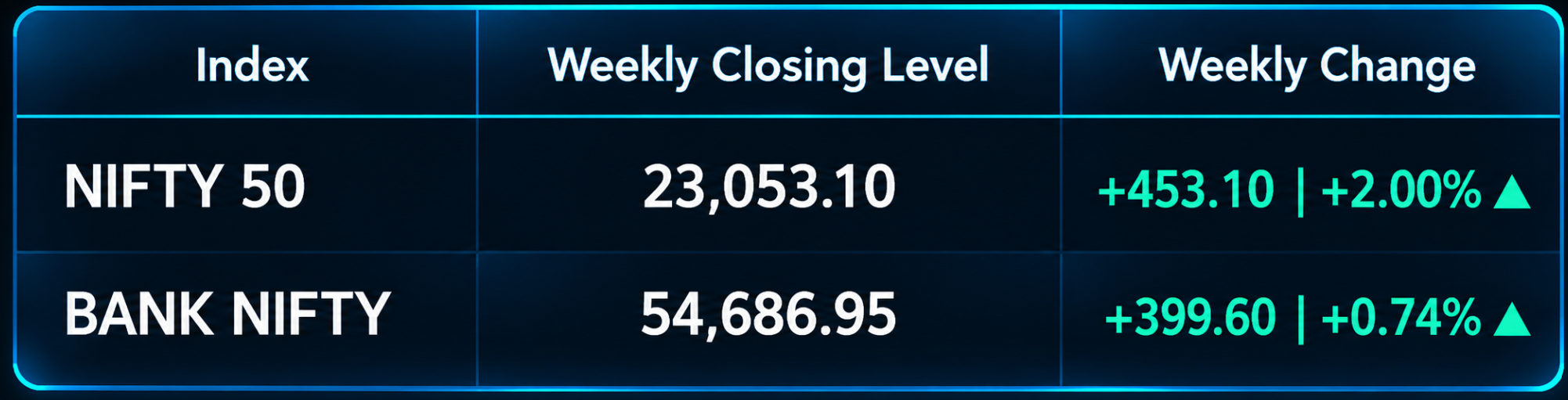
The Nifty 50 gained 453.10 points (+2.00%) to close at 23,053.10, while the Sensex advanced 1,335.70 points (+1.83%) to settle at 74,459.53. Bank Nifty recorded a comparatively modest recovery, rising 399.60 points (+0.74%) to finish at 54,686.95.
The recovery followed the significant correction during October 19–23, when Nifty declined 2.36%. Buying interest returned to technology, pharmaceutical and select large-cap stocks, although weakness persisted in Energy, Auto, FMCG and Consumer Durables.
IT emerged as the strongest sector in Friday's snapshot, gaining 2.32%, followed by Pharma at 1.55%. Consumer Durables declined 1.78%, while Energy and Auto also faced selling pressure. The mixed sector performance suggested that the recovery remained selective.
Crude oil continued to pose a macroeconomic challenge, with Brent trading around $118.42 per barrel in the supplied snapshot. Meanwhile, India VIX stood at 15.30, indicating that market volatility remained an important consideration.
The upcoming week, November 2–6, 2026, will be crucial in determining whether Nifty can sustain above 23,000 and extend its recovery towards 23,300–23,500. Investors will monitor corporate earnings, crude oil prices, global economic developments, institutional flows and geopolitical tensions.
Weekly Market Review.
Market Summary: Sensex & Nifty 50 Performance
Monday, October 26: Indian markets began the week on a positive note, recovering from the previous week's correction. Nifty gained 153.20 points to close at 22,753.20. Buying in select heavyweight stocks supported the recovery, although elevated crude prices and global uncertainty kept investors cautious.
Tuesday, October 27: Markets witnessed a largely range-bound session as investors remained cautious ahead of the US Federal Reserve's policy announcement and major corporate earnings. Nifty closed marginally lower at 22,749.75, reflecting consolidation after Monday's recovery.
Wednesday, October 28: Indian equities faced renewed selling pressure as rising crude oil prices and geopolitical tensions affected sentiment. Nifty declined to 22,698.85, while weakness in IT and Energy weighed on benchmark indices. Select Pharma and Auto stocks provided support.
Thursday, October 29: Markets rebounded sharply, with Nifty reclaiming 22,900 and Sensex surging approximately 905 points. Strong buying in FMCG, Realty and Banking stocks supported the recovery, while improved global sentiment encouraged investor participation.
Friday, October 30: Indian equities extended their recovery, with Nifty gaining 116.35 points (+0.51%) to close at 23,053.10. Sensex advanced 308.49 points (+0.42%) to 74,459.53, while Bank Nifty declined 222.70 points (-0.41%) to 54,686.95. IT and Pharma led the gains, while Consumer Durables, Energy and Auto remained under pressure.
Share Market Live News: The Big Macro Triggers This Week
1. Nifty Gains 2% as Previous Week's Losses Are Recovered
Indian equity markets recovered strongly during October 26–30 after the sharp correction recorded in the previous week.
Nifty gained 453.10 points (+2.00%) to close at 23,053.10, while Sensex advanced 1,335.70 points (+1.83%) to 74,459.53. Bank Nifty gained 0.74%, underperforming the broader benchmarks.
Nifty traded between a weekly high of 23,118.10 and a low of 22,387.35, reflecting considerable volatility and renewed buying interest at lower levels.
The recovery above 22,800 and 23,000 improved the short-term technical structure. However, the index must sustain above these levels to confirm further upside momentum.
The 22,900–23,000 region has emerged as an important immediate support area, while 23,120–23,300 represents the next significant resistance zone.
2. Brent Crude Above $118 Remains a Major Market Concern
Elevated crude oil prices continued to influence investor sentiment despite the recovery in Indian equities.
Brent crude traded around $118.42 per barrel in the supplied market snapshot amid persistent Middle East tensions and concerns over global supply disruptions.
For India, higher crude prices can increase the import bill, put pressure on the rupee and raise transportation and manufacturing costs.
Oil-sensitive industries such as Aviation, Paints, Chemicals, FMCG and Oil Marketing Companies remain vulnerable to sustained increases in energy prices.
A decline in Brent towards $112–115 could provide relief to domestic equities, while a sustained move beyond $120 may intensify inflation and corporate margin concerns.
3. IT and Pharma Stocks Lead the Market Recovery
Technology and pharmaceutical stocks emerged as important contributors to the market recovery.
IT gained 2.32% in Friday's sector snapshot, while Pharma advanced 1.55%, outperforming several major sectors.
Renewed interest in IT companies reflected investor focus on artificial intelligence, digital transformation opportunities and earnings resilience.
Pharmaceutical companies also attracted buying interest, with Dr. Reddy's Laboratories and Apollo Hospitals among the strongest weekly performers.
However, sector participation remained uneven. Consumer Durables declined 1.78%, Energy fell 0.97% and Auto slipped 0.87% in Friday's snapshot.
The divergence indicates that investors continue to favour businesses offering stronger earnings visibility and relatively defensive characteristics.
4. US Federal Reserve Policy Decision Influences Global Markets
The US Federal Reserve's October 27–28 policy meeting remained an important global event during the week.
The central bank maintained its benchmark interest-rate range at 3.75%–4.00%, keeping attention on inflation, economic growth and future monetary-policy decisions.
For Indian markets, US interest-rate expectations influence foreign institutional investment, currency movements and emerging-market valuations.
Investors will now monitor upcoming US employment, manufacturing and services data for indications of future monetary-policy changes.
5. India VIX and Mixed Sector Performance Reflect Continued Caution
India VIX stood at 15.30 in the supplied Friday snapshot, with a daily increase of approximately 1.22%.
Although benchmark indices recovered, the mixed sector performance indicated that investors remained selective.
Friday's sector performance was as follows:
Sector | Daily Change |
|---|---|
IT | +2.32% |
Pharma | +1.55% |
Financial Services | +0.03% |
Metal | -0.54% |
FMCG | -0.62% |
Realty | -0.72% |
Auto | -0.87% |
Energy | -0.97% |
Consumer Durables | -1.78% |
Source: Supplied sector heatmap for Friday, October 30, 2026. These represent one-day changes, not weekly sector returns.
The recovery in Nifty above 23,000 provides some improvement in sentiment. However, broader sector participation will be important for sustaining further gains.
Top Nifty Gainers & Losers Last Week
Top Gainers (1-Week Performance)
TRENT (TRENT): +10.63% | ₹3,017.30
Trent emerged as the strongest performer among the highlighted Nifty 50 stocks, advancing 10.63% during the week.
The sharp recovery reflected renewed buying interest in retail stocks following recent selling pressure. Investors appeared willing to revisit select consumer businesses despite broader concerns over discretionary spending.
The stock's strong weekly performance improved its short-term momentum. However, continued upside will depend on earnings growth, store expansion, operating margins and valuation comfort.
DR. REDDY'S LABORATORIES (DRREDDY): +9.96% | ₹1,352.00
Dr. Reddy's Laboratories gained 9.96%, benefiting from strong buying interest in pharmaceutical stocks.
The company attracted investor attention amid renewed interest in healthcare businesses and expectations surrounding product launches and international market opportunities.
Investors will monitor US business performance, regulatory developments and earnings growth to assess whether the momentum can continue.
APOLLO HOSPITALS (APOLLOHOSP): +9.29% | ₹8,448.00
Apollo Hospitals advanced 9.29%, emerging as another strong performer during the week.
The rally reflected investor interest in healthcare businesses supported by long-term demand for medical services and hospital expansion opportunities.
Hospital occupancy, operating margins, capacity expansion and healthcare profitability will remain important factors for future performance.
Top Losers (1-Week Performance)
SHRIRAM FINANCE (SHRIRAMFIN): -4.84% | ₹823.15
Shriram Finance declined 4.84%, underperforming the broader market despite the recovery in benchmark indices.
Concerns surrounding lending margins, funding costs and credit quality continued to influence sentiment towards financial services companies.
Investors will closely monitor loan growth, asset quality and management guidance before assessing a potential recovery.
COAL INDIA (COALINDIA): -2.13% | ₹389.00
Coal India declined 2.13% during the week amid weakness in select commodity-related stocks.
Investor sentiment remained sensitive to production trends, coal demand, pricing and operational performance.
Future movements will depend on production volumes, e-auction premiums, power-sector demand and dividend expectations.
RELIANCE INDUSTRIES (RELIANCE): -2.11% | ₹1,164.90
Reliance Industries declined 2.11%, remaining under pressure despite the broader market recovery.
Weakness reflected cautious sentiment towards select energy and heavyweight stocks amid elevated crude oil prices and uncertainty surrounding refining and petrochemical margins.
Investors will monitor developments across the company's Energy, Retail and Digital businesses, along with earnings performance and capital expenditure plans.
Institutional Activity: FIIs vs. DIIs
Institutional flows remained largely positive during the week of 26–30 October 2026, with both FIIs and DIIs recording net inflows despite intermittent selling pressure. Foreign Institutional Investors (FIIs) registered cumulative net inflows of approximately ₹6,304.67 crore across five trading sessions. The highest FII buying was witnessed on Tuesday, 27 October, at ₹4,240.39 crore, followed by Friday at ₹3,598.54 crore. However, FIIs remained net sellers on Monday and Thursday, recording outflows of ₹1,462.49 crore and ₹943.60 crore, respectively, indicating selective profit booking amid improving foreign institutional participation.
Domestic Institutional Investors (DIIs) maintained overall buying momentum, registering cumulative net inflows of approximately ₹3,109.79 crore. The highest DII buying was recorded on Monday, 26 October, at ₹2,609.57 crore, followed by Thursday at ₹1,924.41 crore. However, DIIs turned net sellers on Tuesday and Friday, recording outflows of ₹1,250.03 crore and ₹817.51 crore, respectively. Despite these fluctuations, combined institutional inflows of approximately ₹9,414.46 crore reflected positive institutional participation, providing underlying support to the broader market.
Market Outlook & Nifty Prediction for November 2–6, 2026
Nifty enters the upcoming week at 23,053.10, following a 2.00% weekly gain that reversed much of the previous week's decline.
The index traded between 22,387.35 and 23,118.10 during October 26–30, reflecting strong buying interest following the recent correction.
The recovery above 23,000 has improved short-term sentiment. However, sustained buying above 23,120–23,200 will be necessary to strengthen the bullish outlook.
With India VIX at 15.30 and Brent crude near $118.42 per barrel, markets may remain sensitive to geopolitical developments, corporate earnings and global economic data.
A sustained recovery above 23,120–23,200 could encourage buying towards 23,300–23,500. A stronger breakout may extend the recovery towards 23,600.
Conversely, a breakdown below 22,900 could renew selling pressure towards 22,800–22,700, followed by 22,600 and 22,350.
Indicative Nifty Range: 22,600–23,600
Nifty 50 Levels | Range |
|---|---|
Immediate Support | 22,950–22,900 |
Secondary Support | 22,800–22,700 |
Major Support | 22,600–22,350 |
Immediate Resistance | 23,120–23,200 |
Recovery Zone | 23,300–23,500 |
Major Resistance | 23,550–23,650 |
Indicative technical monitoring zones derived from the supplied weekly price range and recent market structure; these are not guaranteed turning points.
The 23,000 level will be particularly important during the opening sessions of the new week. Sustained buying above this level could strengthen the recovery, while failure to hold support may trigger renewed profit booking.
Bank Nifty Outlook
Bank Nifty closed at 54,686.95, gaining 0.74% during the week and underperforming both Nifty and Sensex.
The index recorded a weekly high of 55,068.50 and a low of 53,626.15, reflecting considerable volatility in banking and financial stocks.
Although the weekly recovery improved sentiment, the sector continued to face concerns surrounding earnings growth, funding costs and lending margins.
Bank Nifty needs to reclaim 55,000–55,100 to strengthen near-term momentum. A sustained breakout could encourage a recovery towards 55,400–55,700.
Conversely, a breakdown below 54,400 could trigger weakness towards 54,000 and 53,600.
Bank Nifty Levels | Range |
|---|---|
Immediate Support | 54,400–54,200 |
Major Support | 54,000–53,600 |
Immediate Resistance | 55,000–55,100 |
Major Resistance | 55,400–55,700 |
Banking stocks will remain important during the upcoming week because of their substantial weight in benchmark indices. Stronger participation from financial stocks could support the broader market recovery.
Key Triggers for November 2–6
1. US Economic Data: Manufacturing, services and labour market indicators from the US will influence global sentiment. Investors will assess their implications for future Federal Reserve policy decisions.
2. Q2 FY27 Corporate Earnings: Quarterly results will remain an important driver of stock-specific volatility. Earnings growth, margins and management guidance could influence sector performance.
3. Crude Oil & Middle East Tensions: Brent crude near $118.42 remains a significant concern for India's inflation outlook and corporate profitability. Any further supply disruption could increase market volatility.
4. FII/DII Activity & Rupee: Foreign institutional flows, domestic buying and currency movements will remain important indicators of liquidity. The supplied USD/INR snapshot stands at 94.94.
5. Banking Sector Performance: Following Bank Nifty's modest 0.74% weekly gain, investors will monitor whether financial stocks can strengthen and support the broader recovery.
6. IT & Pharma Momentum: Both sectors demonstrated strong performance in Friday's snapshot. Investors will assess whether buying momentum can continue during the upcoming week.
7. Technical Levels: Nifty must sustain above 22,900–23,000 and reclaim 23,120–23,200 to strengthen its recovery. A sustained break below 22,800 could weaken sentiment.
8. Market Volatility: India VIX at 15.30 indicates the need for disciplined risk management, particularly around corporate earnings and global developments.
Market Holiday: The NSE's 2026 equity holiday calendar lists no scheduled regular trading holiday during November 2–6. The upcoming week therefore contains five scheduled regular trading sessions.
Strategy
Maintain a cautiously positive approach while Nifty trades above 22,900–23,000. A sustained breakout above 23,200 could encourage renewed buying interest towards 23,400–23,600.
Conversely, a sustained breakdown below 22,800 could expose the index to selling pressure towards 22,600 and 22,350.
Traders should avoid aggressive leveraged positions during periods of uncertainty and maintain clearly defined risk management.
Selective opportunities may emerge in fundamentally strong IT, Pharma, Banking and quality large-cap businesses. However, fresh positions should be supported by improving price action, stable market breadth and reasonable valuations.
Stocks to Watch & Best Investment Opportunities for November 2–6, 2026
Based on recent market developments, sector positioning, business fundamentals and long-term growth prospects, the following five stocks stand out as investment candidates for the upcoming week. The selection prioritises earnings visibility, financial strength and long-term opportunities rather than recent weekly price performance alone.
1. Tata Consultancy Services (TCS)
Sector: Information Technology | Investment Horizon: Medium to Long Term
TCS remains an important investment candidate following renewed buying interest in technology stocks and growing opportunities in artificial intelligence-related services.
The company benefits from established global client relationships, a diversified services portfolio and strong cash generation.
Its exposure to AI, cloud computing and enterprise digital transformation provides long-term growth opportunities.
However, slower discretionary technology spending and global economic uncertainty remain key risks.
Investment Outlook: TCS remains a relatively defensive large-cap IT investment candidate for the medium to long term. Investors may consider gradual accumulation during market corrections, subject to valuation comfort and continued earnings stability.
2. ICICI Bank Ltd (ICICIBANK)
Sector: Banking & Financial Services | Investment Horizon: Medium to Long Term
ICICI Bank remains a strong investment candidate, supported by its established banking franchise, diversified loan portfolio and focus on profitability.
The bank's asset quality, deposit growth and operating efficiency remain important strengths.
However, rising funding costs and pressure on net interest margins could influence near-term profitability.
Investors should monitor credit growth, asset quality and management guidance as banking stocks attempt to recover.
Investment Outlook: ICICI Bank offers long-term exposure to India's banking sector. Investors may consider gradual accumulation at reasonable valuations while monitoring margin pressures and earnings growth.
3. Larsen & Toubro (LT)
Sector: Engineering & Infrastructure | Investment Horizon: Long Term
Larsen & Toubro remains an important investment candidate for exposure to India's infrastructure development and industrial capital expenditure.
The company's diversified operations across construction, engineering, infrastructure and technology services provide multiple growth opportunities.
Its order pipeline, project execution and operating margins remain important drivers of future performance.
However, project delays, elevated material costs and international uncertainties could affect profitability.
Investment Outlook: L&T remains a long-term infrastructure investment candidate. Investors should review the latest quarterly results, order inflows and valuations before considering fresh allocations.
4. Bharti Airtel (BHARTIARTL)
Sector: Telecommunications | Investment Horizon: Long Term
Bharti Airtel offers exposure to India's expanding mobile data consumption, broadband connectivity and digital infrastructure.
Growing data usage, customer monetisation and enterprise services remain important long-term growth drivers.
The company's opportunities across mobile services, broadband and data centres provide scope for business expansion.
However, competition, capital expenditure requirements and debt obligations remain key risks.
Investment Outlook: Bharti Airtel remains a long-term telecommunications investment candidate. Investors should evaluate cash-flow generation, leverage, average revenue per user and entry valuation before considering accumulation.
5. Hindustan Unilever (HINDUNILVR)
Sector: FMCG | Investment Horizon: Medium to Long Term
Hindustan Unilever remains an important stock to watch for investors seeking exposure to established consumer brands and relatively defensive businesses.
Its diversified product portfolio, distribution network and brand strength support long-term business stability.
Consumer demand, rural recovery, product pricing and operating margins will remain important indicators of future growth.
However, elevated crude oil prices may increase packaging and transportation costs, potentially affecting profitability.
Investment Outlook: HUL remains a potential defensive long-term investment candidate. Investors should assess its latest quarterly earnings, volume growth and valuation before considering fresh positions.
Investment Outlook
Among the five selected stocks, TCS provides exposure to established IT services and growing AI-related opportunities, while ICICI Bank offers exposure to India's banking and credit growth.
Larsen & Toubro remains positioned to benefit from infrastructure development and industrial capital expenditure. Bharti Airtel offers opportunities linked to digital connectivity, while Hindustan Unilever provides exposure to established consumer businesses.
For the week of November 2–6, 2026, investors should remain selective as Nifty trades near 23,053 following its strong weekly recovery. Crude oil prices, global developments, quarterly earnings and institutional flows will remain important market drivers.
From a medium- to long-term perspective, these five companies merit further fundamental analysis. However, strong business fundamentals do not automatically imply attractive valuations. Investment decisions should consider earnings growth, historical valuations, current market prices and individual risk tolerance.
Investors should favour staggered investments, valuation discipline and appropriate diversification rather than deploying substantial capital during periods of market uncertainty.
💡 Pro-Tip: Want a real-time technical analysis for these stocks? Ask LiMo, our AI co-pilot, for an instant buy/sell rating.
Discover Investment Opportunities with Liquide
Available on both Google Play Store and Apple Appstore, Liquide offers up-to-date market analysis, expert recommendations and real-time insights to guide your investment decisions.
Download the Liquide App today and enhance your financial journey.
Disclaimer: The information provided in this article is for informational and educational purposes only and does not constitute financial, investment or trading advice.
Stock, commodity and currency markets involve significant risk. Readers are strongly advised to consult with their financial advisors before making any investment decisions.
For a detailed Disclaimer, please visit our website https://liquide.life/