
Market Carnage: Why Nifty & Sensex Fell 5% | Weekly Recap
Indian markets witnessed their steepest weekly fall in 4 years, with the Nifty & Sensex plunging over 5%. As the Strait of Hormuz closure pushes crude oil past $100, we analyze the impact on sectors & stocks. Read our outlook and key levels for Nifty and Bank Nifty for the week ahead.


Markets closed lower for the third straight week, erasing nearly Rs 20 lakh crore in investor wealth!
What triggered the sell-off? Explore the biggest developments, overlooked stories and our outlook for the week ahead in your Weekly Report.
Carnage!
- Key indices plunged over 5.3% last week, marking their largest weekly decline in nearly four years. Except for Tuesday’s session, the market ended lower on all other days of the week.
- All 16 major sectors ended the week in the red, while broader markets also weakened — mid-caps declined 4.6% and small-caps fell 3.7%.
- Volatility surged as India VIX climbed nearly 14% during the week, and has jumped almost 65% over the past month.
The Big Stories
- The key driver behind last week’s sell-off on Dalal Street remained the escalating war in Iran, with the situation showing no signs of easing anytime soon.
- Global markets were rattled by the near-total closure of the Strait of Hormuz, a critical shipping route for oil.
- Crude prices surged past $100 per barrel, raising concerns over inflation and economic growth in India.
The Winners
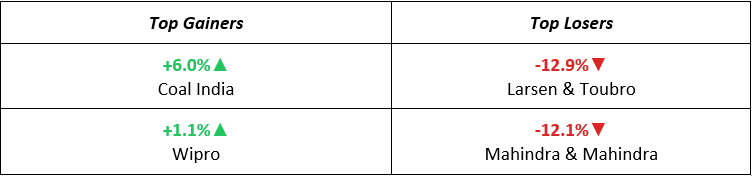
- Despite a largely red market, a few stocks managed to hold their ground. Coal India emerged as the week’s top gainer, rising 6% on expectations of strong summer power demand.
- Wipro followed with a 1.1% weekly gain, supported by investor optimism around its new multi-year contract to transform US insurer TruStage’s retirement services operations.
The Losers
- Larsen & Toubro was the week’s worst performer, plunging 12.9% amid concerns over its high exposure to the Middle East in its order book.
- Mahindra & Mahindra also tumbled 12.1% during the week, as fears of a potential national natural gas shortage weighed on the auto sector.
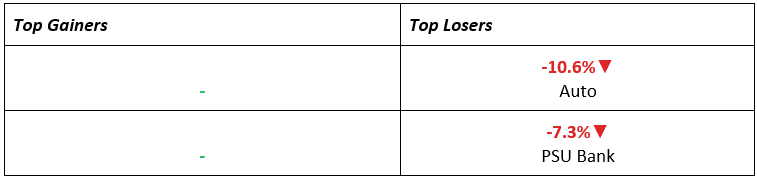
- The Auto index emerged as the biggest laggard, dropping 10.6% — its steepest weekly fall in six years — as investors worried that the Middle East conflict could disrupt production and exports.
Meanwhile…
- Data showed price pressures building for the fourth consecutive month, with retail inflation rising to 3.2% in February. Economists caution that the ongoing Middle East conflict could push inflation above 5%.
- Even after global governments agreed to release 400 million barrels of crude oil from strategic reserves, oil prices have surged and remained above $100 per barrel as of Friday.
- The Indian rupee extended losses for the second consecutive week, touching a fresh record low of 92.47 against the US dollar in Friday’s session amid persistent geopolitical tensions.
MARKET BRIEF
Key Indices

Trending Stocks
Sector Insights
Institutional Data

MARKET OUTLOOK

Sectors To Watch


Our Take
- Market activity continues to be shaped by the rapidly escalating situation in the Middle East, keeping investor sentiment cautious for now.
- Markets are likely to remain largely headline-driven, which could lead to sharp short-term swings.
- Given the current backdrop, we expect the Nifty to trade with a bearish bias in the week ahead, likely moving within the 22,700–23,700 range unless there are signs of easing tensions.
Discover Investment Opportunities with Liquide
Unlock the potential of informed investing with Liquide, featuring pioneering tools like LiMo, an AI co-pilot for stock investing. Available on both Google Play Store and Apple Appstore, Liquide offers up-to-date market analysis, expert recommendations, and real-time insights to guide your investment decisions.
Download the Liquide App today and enhance your financial journey with Liquide's cutting-edge features.
Frequently Asked Questions (FAQs)
Q1: Why did the Indian stock market fall so sharply this week?
The primary driver was the escalating conflict in the Middle East and the closure of the Strait of Hormuz, which sent crude oil prices above $100 per barrel. This triggered a sell-off across all 16 major sectors, wiping out nearly ₹20 lakh crore in investor wealth.
Q2: Which sectors were the most affected by the market crash?
The Auto index was the biggest laggard, dropping 10.6%—its steepest fall in six years. Other heavily impacted sectors included PSU Banks and stocks with high Middle East exposure, such as Larsen & Toubro (L&T), which fell nearly 13%.
Q3: What is the outlook for Nifty and Bank Nifty for the coming week?
Market sentiment remains cautious and headline-driven. For the upcoming week, the Nifty is expected to trade with a bearish bias within a range of 22,700–23,700, while Bank Nifty is pegged between 52,600 and 55,200.
Q4: Why did Coal India and Wipro rise despite the market sell-off?
Coal India gained 6% due to anticipated high power demand for the summer, while Wipro rose 1.1% following a significant multi-year contract with US insurer TruStage.
Q5: How has the Middle East crisis impacted the Indian Rupee and inflation?
Persistent geopolitical tensions pushed the Indian Rupee to a record low of 92.47 against the US dollar. Additionally, retail inflation rose to 3.2% in February, with economists warning it could exceed 5% if oil prices remain high.