
SpaceX IPO, Valuation & Risks: Can It Become the Next Tesla?
As SpaceX prepares for its historic public market debut under ticker SPCX, investors are weighing a $1.75 trillion valuation against core growth drivers like Starlink and orbital AI infrastructure. Is it the next Tesla, or is the starting price too high for retail investors?

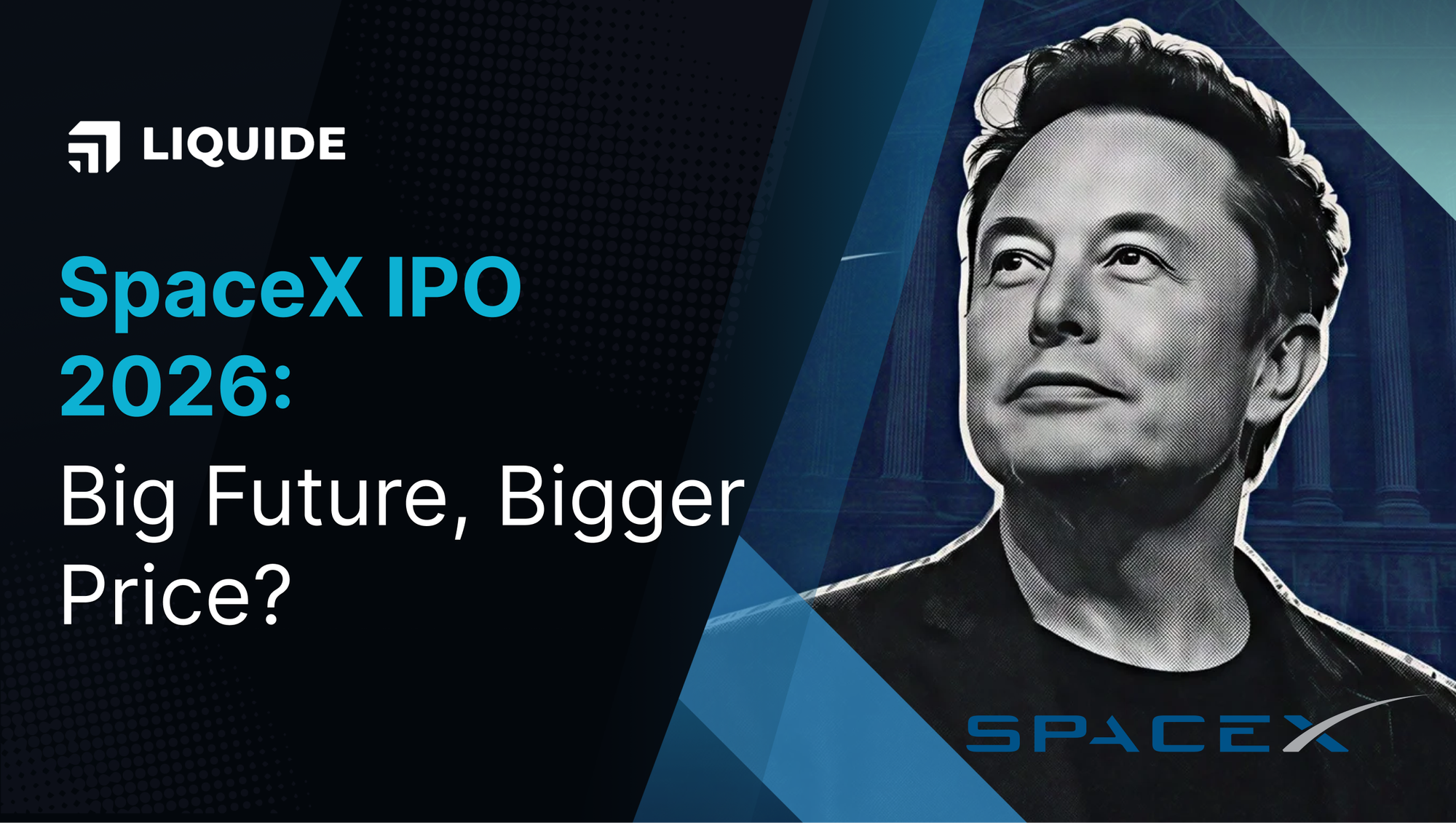
The SpaceX IPO is no longer just another Wall Street rumour. After years of speculation around whether Elon Musk would ever take his aerospace empire public, SpaceX is now preparing for what could become one of the largest IPOs in global market history.
The story has everything investors love: Elon Musk, reusable rockets, Starlink, AI infrastructure, space-based data centres, government contracts and a rare chance for retail investors to participate in a company that was previously accessible only to private-market investors.
But the most exciting IPOs are not always the safest ones.
SpaceX IPO 2026: Date, Size & Valuation
SpaceX is targeting a public listing on Nasdaq under the ticker SPCX, with trading expected to begin on Friday, 12 June 2026, after pricing expected on Thursday, 11 June 2026.
The Elon Musk-led company is planning to sell around 555.6 million shares at a proposed price of $135 per share, aiming to raise roughly $75 billion at a target valuation of about $1.75 trillion.
If completed at that size, it would surpass Saudi Aramco’s $29.4 billion IPO record and become the largest IPO in history.
SpaceX may allocate up to 30% of the offering to retail investors, though actual retail access will depend on participating platforms and final allocation.
For retail investors, the excitement is easy to understand. A company that dominates rocket launches, owns Starlink, works closely with governments and is now pitching itself as a future AI infrastructure giant is finally coming to the public markets.
That could create massive participation.
It could also create massive hype.
SpaceX IPO Valuation: Is $1.75 Trillion Too Expensive?
The biggest question is not whether SpaceX is an extraordinary company. It clearly is.
The real question is whether it is an extraordinary investment at a ~$1.75 trillion starting valuation.
Consider the baseline mathematics:
- SpaceX reportedly generated roughly $18.67 billion in revenue in 2025.
- At a ~$1.75 trillion market cap, the company would list at an astronomical ~94 times its trailing revenue.
That is an extremely aggressive valuation. At this level, investors are not valuing SpaceX like a traditional aerospace company. They are valuing it like a future technology ecosystem.
In simple terms, the market is not just pricing SpaceX for what it is today. It is pricing SpaceX for what it could become over the next decade.
It is a bet on execution, market creation and the belief that space could become the next major layer of global technology infrastructure.
The opportunity is massive. But at 94 times trailing revenue, the margin for disappointment is also very thin.
SpaceX Business Model & Growth Drivers
The core valuation story rests on three major pillars:
1. Rocket Launch Biz: Falcon 9 & Starship
Founded by Elon Musk in 2002, SpaceX first gained attention through its rocket launch business.
In 2008, Falcon 1 became the first privately developed, fully liquid-fuelled launch vehicle to successfully reach Earth orbit. Since then, reusable rocket technology and lower launch costs have helped it build a dominant position in commercial space launches.
This launch capability is the base of the entire SpaceX ecosystem. Falcon 9 gave SpaceX scale. Starship, if successful, could multiply that scale significantly.
2. Starlink: A Predictable Global Subscription Engine
While rockets built the SpaceX brand, Starlink has become one of its most important commercial businesses.
SpaceX reported over 9,600 Starlink satellites as of 31 March 2026, a dominant share of active maneuverable satellites in orbit.
This changes the nature of the business. SpaceX is no longer only a launch company with project-based revenue. Through Starlink, it is building a global subscription business with recurring cash flows.
SpaceX’s connectivity segment, primarily driven by Starlink, generated about $7.17 billion in adjusted EBITDA in 2025.
This recurring revenue base is a key reason investors may value SpaceX more like a technology company than a traditional industrial business.
3. AI Frontier: Orbital Data Centres & Cloud Computing
The most ambitious part of the SpaceX IPO story is its potential move into AI infrastructure.
SpaceX is reportedly exploring orbital data centres as a major future opportunity. The idea is bold: use space-based infrastructure powered by solar energy to support AI workloads, while reducing some of the power, land and cooling constraints faced by Earth-based data centres.
This is the part of the story that could excite growth investors the most. But, it is also the hardest to value.
Orbital AI infrastructure is not yet a proven mainstream business. The technology, economics, launch costs, maintenance, chip performance, data transmission, regulation and competition remain difficult to model confidently.
SpaceX has presented a total addressable market of around $28.5 trillion, with a large portion linked to AI. If it works, the upside narrative can be enormous.
If it does not, investors may realise they paid today for a business that could take many years to prove itself.
Evaluating the "Musk Premium"
To map out how SpaceX stock might behave post-listing, investors are naturally studying Tesla. Tesla proved that a stock can trade far beyond traditional valuation models when investors believe deeply in a founder-led future narrative.
Tesla wasn’t bought because of its immediate quarterly auto margins. Investors bought into a much larger story around electric vehicles, autonomous driving, robotics, software and clean energy.
That same “Musk premium” could apply to SpaceX.
Investors may not value SpaceX on current revenue, profit or cash flow. They may value it on ambition. They may buy into the idea of reusable rockets, global satellite broadband, space-based computing, AI infrastructure and eventually, Mars.
That kind of narrative can create strong market momentum. But it can also create dangerous volatility.
Is the SpaceX IPO Good for Retail Investors?
While the Tesla comparison is instructive, it comes with a major warning for latecomers: Tesla entered the public markets at a tiny fraction of its eventual peak valuation. Public investors had more than a decade to ride the narrative curve from a billion-dollar valuation to a trillion-dollar company.
SpaceX, by contrast, would be entering the public market at mega-cap scale. If it lists around a $1.75 trillion valuation, public investors would be buying into a company where a large part of future success is already reflected in the starting price.
That does not mean SpaceX cannot compound further, but the margin for disappointment would be much thinner than it was for Tesla’s public investors in 2010.
What Retail Investors Should Understand
The SpaceX IPO will likely create a strong emotional pull. The brand is powerful. The founder is iconic. The business is futuristic.
But IPO investing should not be driven by excitement alone.
Investors should ask a few hard questions:
- Can Starlink continue scaling profitably without hitting subscriber saturation?
- Can Starship become a commercially reliable, high-frequency launch vehicle?
- Can orbital AI infrastructure move from a pitch deck presentation to tangible revenue?
These are not small questions. They are the questions that will decide whether SpaceX becomes the next great public-market wealth creator or one of the most overhyped listings of the decade.
SpaceX IPO: Key Risks
- The biggest risk is valuation. At nearly 94 times trailing revenue, SpaceX has very little room for disappointment.
- The second risk is profitability. SpaceX showed strong revenue growth in 2025, but also swung to a net loss of $4.94 billion. Investors will need to track whether growth can translate into sustainable earnings.
- The third risk is execution. SpaceX is trying to scale multiple difficult businesses at the same time and some of the most exciting parts of the story, especially orbital AI infrastructure, may take years to prove commercially.
Conclusion: Big Future, Bigger Price?
SpaceX may be one of the most important companies of the next decade. Its ambition is unmatched, its execution history is rare and its role in rockets, satellites, defence, connectivity and AI infrastructure could make it a defining business of the future.
The IPO may be historic. The story may be powerful. The opportunity may be massive.
But for retail investors, the real question is not whether SpaceX can reach the stars.
It is whether the valuation already has.
SpaceX IPO: Frequently Asked Questions (FAQ)
What is the SpaceX IPO date and stock ticker?
The SpaceX IPO is expected to price on Thursday, June 11, 2026, with public trading scheduled to begin on Friday, June 12, 2026. The company will list on the NASDAQ exchange under the stock ticker symbol SPCX.
What is the expected SpaceX valuation at listing?
SpaceX is targeting a starting market valuation of approximately $1.75 trillion. The company plans to issue 555.6 million shares at a proposed price of $135 per share, aiming to raise roughly $75 billion. This transaction will make it the largest initial public offering in global financial history.
Can retail investors buy SpaceX IPO shares?
Yes. In an unusual departure from traditional Wall Street listing structures, SpaceX has allocated up to 30% of its total IPO shares directly to retail investors. Individual investors can request allocations through participating consumer brokerage platforms.
What does SpaceX do and what are the main revenue drivers?
The ~$1.75 trillion valuation rests on three distinct business units:
1. Launch Services: The dominant commercial rocket business driven by Falcon 9 scale and future Starship deployment.
2. Starlink: A highly scalable global satellite broadband subscription engine that generated over $7.1 billion in adjusted EBITDA in 2025.
3. Orbital AI Infrastructure: A futuristic growth segment involving space-based, solar-powered data centres designed to bypass Earth's land, power and cooling constraints for massive AI workloads.
Is SpaceX financially profitable?
While SpaceX has demonstrated explosive revenue growth—generating roughly $18.67 billion in 2025, the company also swung to a net loss of $4.94 billion due to the massive capital expenditures.
Disclaimer: This content is strictly for educational, informational and discussion purposes only and does not constitute a personal recommendation, investment advice or an offer to buy or sell securities.
Investment in securities market, including Initial Public Offerings (IPOs), are subject to market risks. Read all the related documents carefully before investing. Past performance is not indicative of future results.
The valuation, financial data and narrative analysis provided herein are based on publicly available reports and speculative market data. No representation or warranty, express or implied, is made as to its accuracy or completeness.
Investors must consult a certified financial advisor and assess their unique risk appetite and financial suitability before making any investment decisions.
For a detailed disclaimer, please visit our official website https://liquide.life/