
Weekly Market Review: Nifty 50, Sensex Outlook After Latest US-Iran War Update
Nifty 50 and Sensex managed to close with modest gains amid volatility. In this weekly market review, we decode the latest US-Iran war updates, the potential reopening of the Strait of Hormuz and key stocks to watch from May 25–29.


The Indian stock market managed to squeeze out a modest weekly gain, but rising global bond yields and the threat of an energy supply disruption kept investors on edge.
In this Weekly Market Review, we break down the critical triggers driving the current market trend, the economic impact of the Strait of Hormuz blockade and the technical Nifty 50 prediction for the week ahead.
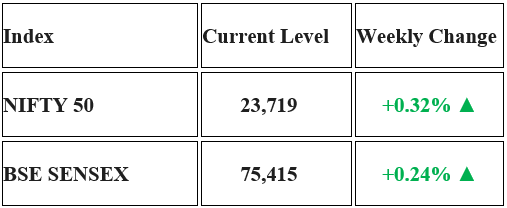
Market Summary: Sensex & Nifty 50 Performance
The Indian equity markets traded rangebound last week, lacking a clear directional bias. A sudden surge in long-term bond yields across the globe has made equity investors jittery.
Why are bond yields rising? Since last week, global bond markets have begun pricing in the inflation fallout from the escalating West Asia crisis and threats surrounding the closure of the Strait of Hormuz.
Top Stock Market News This Week
1. West Asia Crisis Triggers Fuel Hikes
The conflict between the US and Iran has pushed the global energy ecosystem to the brink.
With the Strait of Hormuz facing persistent shipping disruption threats, retail fuel prices in India felt the heat—petrol and diesel prices were hiked for the third time in ten days.
2. Global GDP Forecast Lowered by United Nations
The United Nations’ Department of Economic & Social Affairs, in its mid-year update, pegged global GDP growth for this year at 2.5%. This is 0.2 percentage points lower than its earlier estimate, down from the 3% growth recorded last year.
3. Indian Rupee (INR) Hits Fresh Lifetime Low
The Indian Rupee (INR) slipped to a historic lifetime low of 96.96/$ last week.
Surging global bond yields, elevated crude oil prices and relentless selling by Foreign Institutional Investors (FIIs) continue to weigh heavily on domestic currency sentiment.
Sector Analysis
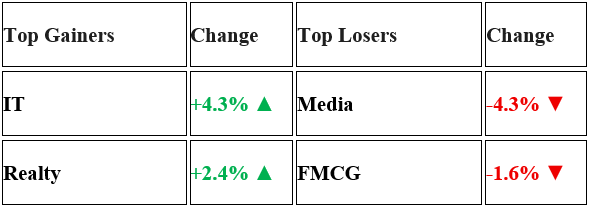
The divergence between sectors was stark last week. IT and Realty, which were the previous week’s top losers, staged a sharp trend reversal to emerge as the top gainers.
Conversely, Media and FMCG shares remained under heavy selling pressure.
Top Nifty Gainers & Losers Last Week
Stock Analysis: Why They Moved
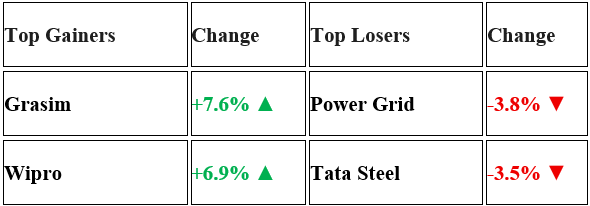
- Grasim Industries: Emerged as the week’s top gainer after the Aditya Birla Group flagship company reported that its net loss narrowed significantly in Q4 FY26, while revenue surged 32% YoY.
- Wipro: Surged in line with the broader IT sector recovery. The IT major has fixed June 5, 2026, as the record date for its massive ₹15,000 crore share buyback plan—its first buyback program in nearly three years.
- Power Grid: Turned into the week's top loser after reporting a weak set of earnings. Operating margins contracted sharply to 78% from 83% in the year-ago quarter.
- Tata Steel: Fell despite a 147% YoY surge in Q4 profit. Investors weighed near-term margin pressures stemming from elevated raw material costs and emission/regulatory uncertainties affecting its Netherlands plant operations.
Also Read: Tata Steel Q4 Results 2026: Profit Jumps 147%, ₹4 Dividend Declared
Institutional Activity: FIIs vs. DIIs
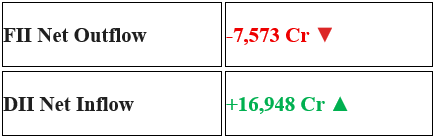
The tug-of-war between institutional investors continued. Foreign Institutional Investors (FIIs) remained net sellers, while Domestic Institutional Investors (DIIs) acted as the market's safety net.
Latest News on US-Iran War
While the Indian Rupee remains under pressure and retail fuel inflation edges higher, a major geopolitical development over the weekend could radically shift market dynamics.
According to an Axios report published on Saturday, the U.S. and Iran are close to signing a deal for a 60-day ceasefire extension.
Under this proposed agreement, the critical Strait of Hormuz would reopen, allowing Iran to freely sell oil while bilateral negotiations resume on curbing its nuclear program.
Market Impact & Nifty Prediction for May 25–May 29
If finalized, this diplomatic breakthrough will drastically ease global supply chain anxieties and cool down Brent crude oil prices.
For an import-dependent economy like India, a drop in crude prices offers immediate relief—stabilizing the Rupee, checking domestic inflation and boosting overall investor risk appetite across Indian equities.
Conversely, should these weekend negotiations hit an unexpected roadblock, the market will likely slip back into a cautious, wait-and-watch mode, keeping equity indices highly sensitive to headline risks.
Nifty 50: Key Support & Resistance Levels
A formal signing of the 60-day ceasefire could serve as a powerful bullish trigger, potentially driving the Nifty 50 to breakout past immediate overhead resistance and test the 24,000 psychological barrier.
But if the deal stalls, expect the index to consolidate and test support closer to the 23,350 mark.
Strategy Tip: Avoid aggressive index-level bets. Focus on stock-specific opportunities within the Q4 FY26 earnings season. Prioritize companies with strong bottom-line growth and positive management commentary.
Stocks to Watch & Investment Opportunities
This week, we are tracking tactical opportunities in:

🎯 Stocks on the Radar
- Hindalco Industries (HINDALCO)
- Steel Authority of India (SAIL)
- Axis Bank (AXISBANK)
- Varun Beverages (VBL)
- Max Financial Services (MFSL)
💡 Pro-Tip: Want a real-time technical analysis for these stocks? Ask LiMo, our AI co-pilot, for an instant buy/sell rating.
Frequently Asked Questions (FAQs)
Q: Which companies are announcing Q4 results next week?
Major Indian corporates scheduled to announce their Q4 FY26 earnings next week include ONGC, Suzlon Energy, IRCTC, NBCC, Cummins, Bata India, Asian Paints and Glenmark Pharmaceuticals.
Q: How does the US-Iran war affect the Indian stock market?
The conflict directly threatens the Strait of Hormuz, a critical maritime chokepoint through which a fifth of the world's petroleum passes. Disruptions here cause global crude oil prices to spike, which hurts India’s macro economy by widening the current account deficit, weakening the rupee and stoking domestic inflation (as seen in the recent hikes in retail fuel).
Q: Why is the Indian Rupee (INR) falling against the US Dollar (USD)?
The Indian Rupee hit a historic low of 96.96/$ due to macro pressures: surging global bond yields, elevated Brent crude oil prices driven by geopolitical tensions in the Middle East and aggressive net selling by Foreign Institutional Investors (FIIs) pulling capital out of emerging markets.
Discover Investment Opportunities with Liquide
Available on both Google Play Store and Apple Appstore, Liquide offers up-to-date market analysis, expert recommendations and real-time insights to guide your investment decisions.
Download the Liquide App today and enhance your financial journey.
Disclaimer: This article is solely for educational purposes. The securities / investments quoted here are not recommendatory.
Investors are strongly advised to consult with their financial advisors before making any investment decisions.
For a detailed Disclaimer, please visit our website https://liquide.life/