
Middle East Crisis 2026: How Rising Oil Prices Impact Indian Stocks
With the Strait of Hormuz under threat and crude oil prices surging, the Indian stock market is entering a phase of high volatility. From sectoral winners and losers to the crucial role of Gold as a hedge, here is everything an Indian investor needs to know to navigate the 2026 energy crisis.

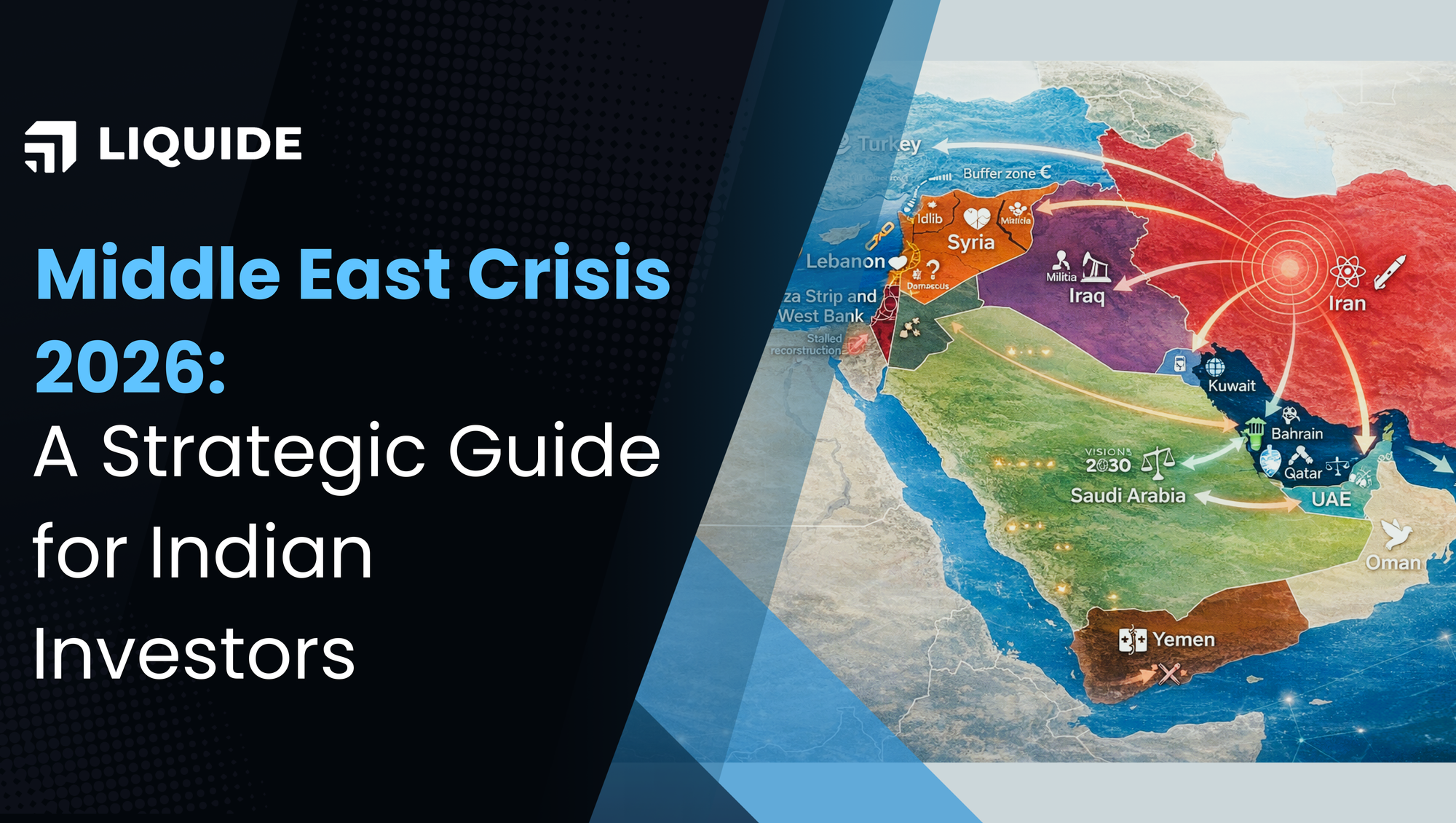
While the 104-mile stretch of the Strait of Hormuz feels worlds away, for the Indian investor, it is currently the most expensive piece of geography on the planet.
The Middle East conflict between Iran, Israel and the United States has once again pushed global financial markets into uncertainty. What began as a military escalation has quickly evolved into a major global energy crisis, sending crude oil prices higher, triggering volatility in stock markets and raising concerns for oil-importing countries like India.
For Indian investors, understanding the impact of rising oil prices on the Indian economy, stock market sectors, inflation and the rupee is critical right now. Let us break this down in a structured and practical way.
Why the Strait of Hormuz Governs Your Portfolio
At the heart of the crisis lies a narrow waterway connecting the Persian Gulf to the Gulf of Oman and the Arabian Sea. It is the world’s most critical energy chokepoint, and here is why its closure is a "black swan" event:
- Global Oil Flow: Over 20% of global oil supply (nearly 20 million barrels per day) passes through this strait.
- Blockade Risk: Iran’s Revolutionary Guards have issued warnings halting ship passage. Major trading houses have already suspended shipments, leading to a massive backlog of tankers near ports like Fujairah.
- Freight & Insurance: Benchmark rates for Very Large Crude Carriers (VLCC) have already tripled since the start of 2026, adding a hidden "security premium" to every liter of fuel.
What Happens If Oil Stays Above $80?
Before the recent strikes, Brent crude sat comfortably between $67 and $70. Now, the trajectory is steeply vertical.
- Goldman Sachs estimates that losing 1 million barrels a day of Iranian exports would add roughly $8 to oil prices.
- Rystad Energy predicts a wider regional conflict could command a $10–$15 premium.
- Tortoise Capital warns that a sustained Hormuz disruption could easily push prices above $100.
The India Factor: India imports over 85% of its crude oil and Middle Eastern suppliers account for more than half of those imports. If Brent crude sustains above $80 per barrel, it would widen India's current account deficit, push domestic inflation higher and put pressure on the rupee.
However, markets are forward-looking. If tensions cool quickly, crude could retrace just as fast.
How Much Does India Depend on the Middle East?
As per December 2025 data:
- 58% of India’s crude imports come from the Middle East
- ~45% of India’s crude supply passes through the Strait of Hormuz
- Russia supplies have reduced, increasing reliance on Gulf nations
If disruptions intensify, India may need to:
- Increase imports from the US and Latin America
- Potentially revive Russian supplies
- Pay higher freight and insurance costs
All of this increases landed crude cost for India.
Beyond Oil: The LNG & LPG Factor
- Natural Gas (LNG): Qatar, the world’s second-largest LNG exporter, is in the direct line of fire. Since 100% of Qatari LNG, which accounts for nearly 20% of global LNG supply, must pass through Hormuz, a closure would trigger a bidding war between Asian and European buyers, sending electricity and industrial costs soaring.
- LPG Supply: Iran is a major LPG supplier. Any disruption forces heavyweights like China to scramble for alternatives, creating a "cascading demand" that spikes prices for Indian households and commercial users.
Stock Market Impact: Winners & Losers
Indian markets have mirrored the acute anxiety seen on Wall Street. On Monday, March 2, the Nifty 50 and BSE Sensex both indices shed over 1%. Perhaps more telling was the India VIX (Volatility Index), which spiked 25% in one single session.
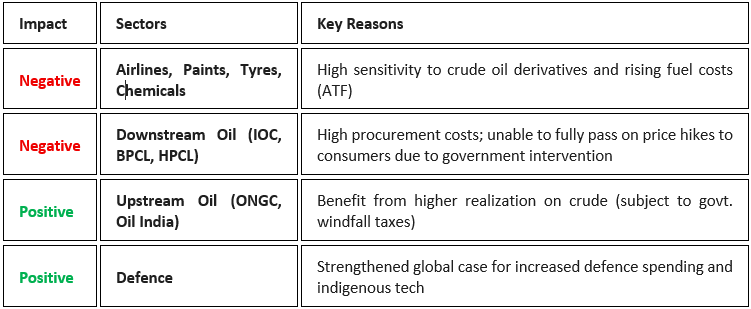
If this conflict enters a "prolonged" phase, the following sectoral playbook will define the winners and losers on Dalal Street:
Final Thoughts: Manage Risk, Not News
History shows that markets eventually price in the "war premium." On average, while major armed conflicts trigger an immediate flight from risky assets, the impact is often short-lived.
In the medium term, equity markets tend to recover as the shock fades; historically, the "peak of conflict" has often provided the most strategic entry point to increase equity exposure.
We saw this resilience during the rebound following the February 2026 US-India trade deal, which lowered reciprocal tariffs to 18% and signalled a new era of bilateral cooperation.
For investors who missed that rally, the current volatility creates a second window. Markets are approaching levels where staggered, value-based buying should be the priority over emotional selling.
Investor Strategy
- Don’t Panic: Geopolitical noise is temporary; the structural growth of the Indian economy remains the long-term driver.
- The Safe Haven Pivot: In times of extreme uncertainty, diversify. Allocating 5–10% of your portfolio to Gold acts as a critical hedge against both currency depreciation and geopolitical escalation.
- Accumulate Quality: Focus on "Moat" companies—those with the pricing power to pass on rising input costs to consumers without sacrificing market share.
- Stay Liquid: Keep "dry powder" ready. Use the 1-2% intraday dips in fundamentally strong sectors to build positions.
- Maintain Discipline: Short-term traders should remain extremely cautious in oil-sensitive sectors (Paints, Aviation), while long-term investors must stick to their asset allocation targets.
Unless the flow through the Strait of Hormuz is halted for a sustained period, this just remains a volatility event. The dust will settle. Your job as an investor isn't to predict the next strike but to ensure your portfolio is still standing when the smoke clears.
Stay calm. Stay structured. Stay invested.
Don’t Navigate the Crisis Alone
In a market driven by geopolitical headlines, expert guidance is your best hedge. Get real-time alerts on stocks, expert portfolio health checks and curated investment themes tailored for the 2026 economic landscape.
Download the Liquide App Now — Your guide for smarter, data-driven investing.