
Middle East War & Market Sell-off: Should You Panic or Buy the Dip?
The Middle East conflict has triggered a global market sell-off and sent crude oil prices soaring. Discover why the 12-month outlook remains positive and how to position your portfolio for the recovery.


The escalating conflict in the Middle East has sent shockwaves through the global economy, leaving many investors grappling with a critical question: Is it time to exit the market?
As hostilities spread across the region’s oil-producing heartland, the immediate reaction has been a sharp stock market sell-off. The impact is being felt globally, with Asian markets under heavy pressure—its benchmark share index fell as much as 5.6%, with South Korea sliding about 8% and Japan nearly 7%.
Meanwhile, futures for US and European equity indices have also dropped, signalling that the sell-off is echoing across global markets as investors weigh the risks of supply chain disruptions and inflationary pressure.
However, historical data suggests that while "fear premiums" trigger short-term turbulence, the long-term Sensex returns tell a different story.
Here is a data-backed analysis of the current market scenario and what history teaches us about investing during wartime.
Current Market Scenario: The "Fear Premium" in Action
Global assets are currently pricing in a significant "fear premium." The intensity of this shift is visible in three critical areas:
- Crude Oil Prices: Brent crude surged 12% last Friday, followed by a staggering 25%+ intraday jump today.
- Volatility Spike: Wall Street’s fear gauge, the VIX, reached 29.49, its highest level since April 2022 — a stark reflection of the anxiety gripping investors worldwide.
- Local Pressures: A weakening Rupee and relentless selling by FIIs are adding layers of concern for domestic equity investors.
Technical View: Where is the Bottom?
While headlines drive the narrative, the price charts reveal where the "smart money" is likely to step in. We are currently approaching critical technical zones that will decide the next move:
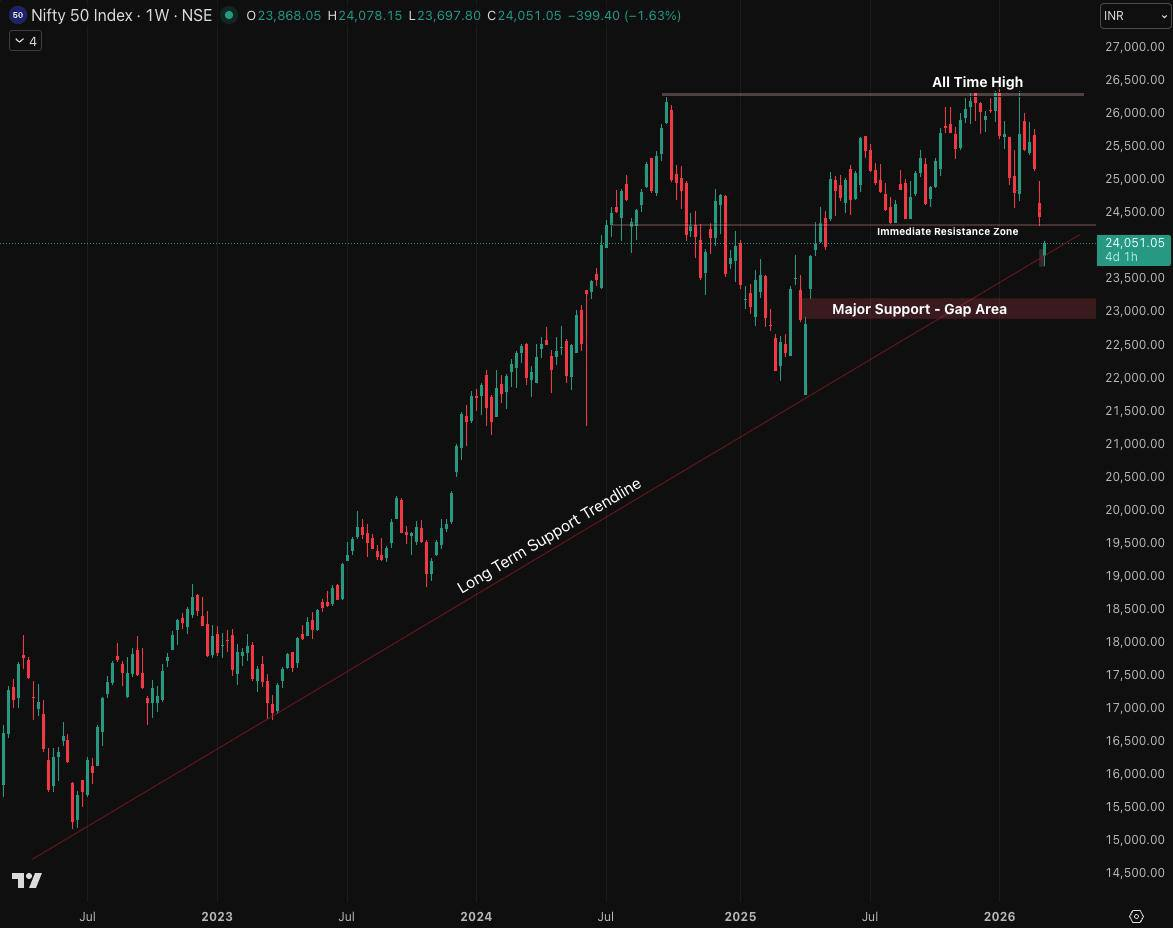
- Nifty 50: After a significant correction, Nifty is approaching a major support zone around 23,500–23,800. This area aligns with the long-term rising trendline—a region where buyers have historically stepped in.
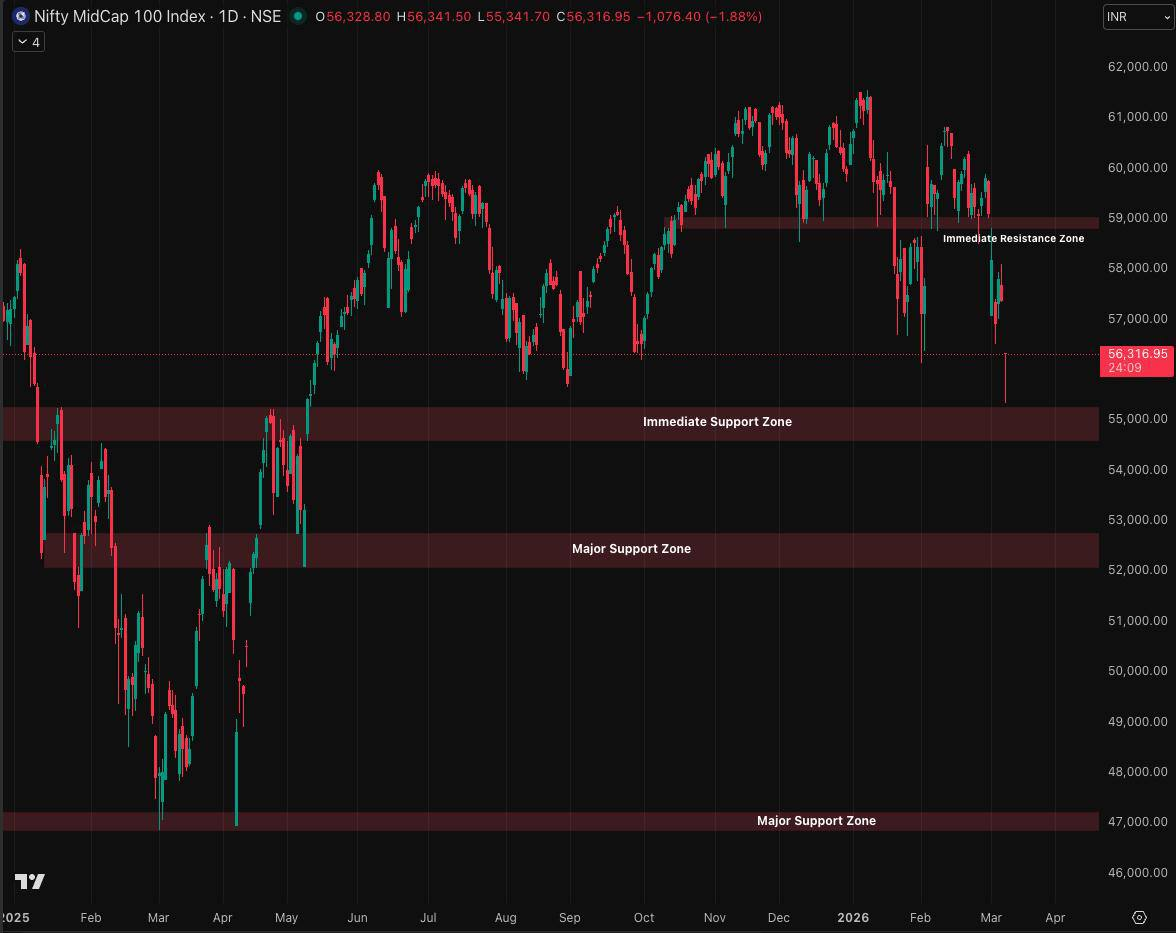
- Midcap Index: Having corrected sharply, Midcaps are testing the 55,000 support zone. A hold here could trigger a relief bounce; however, a break below could see a slide toward 52,000-53,000.
- Smallcap Index: Trading close to the 15,000 support zone, this index remains the anchor for broader market sentiment.
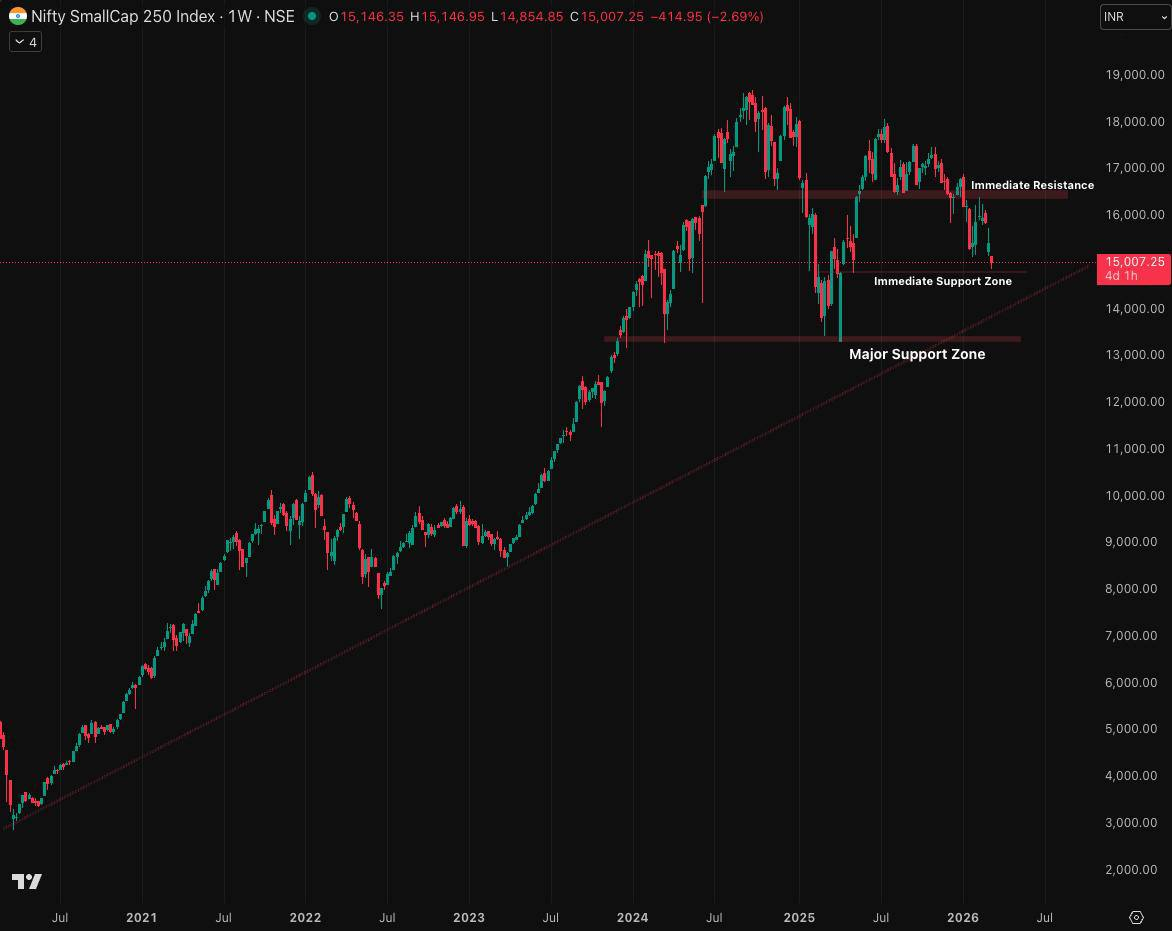
Near-Term View: If these supports hold, expect a short-covering bounce. If they break, further downside pressure may emerge. The next few sessions are vital to determine if the market is forming a base.
Historical Analysis: Why Macro Trends Outlast Geopolitical Conflict
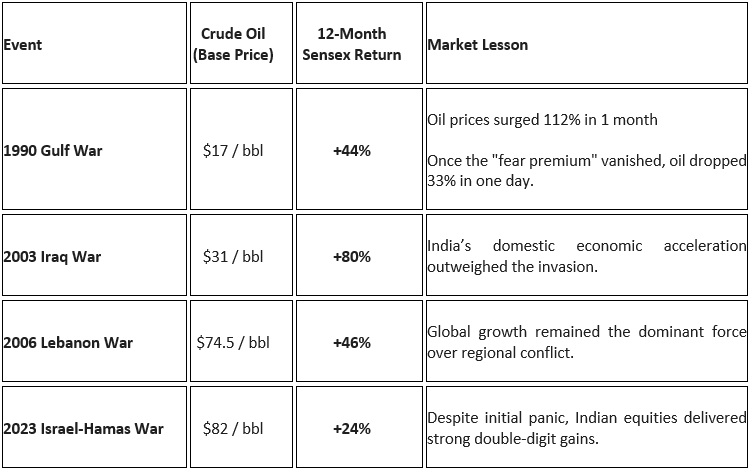
History proves that geopolitical shocks rarely alter long-term market trends unless global supply chains are permanently broken. A look at previous Middle East wars reveals a consistent pattern of recovery:
The Path Forward: Investing During Volatility
The data is clear: the 12-month outlook for markets following a conflict is almost always positive. This confirms that markets frequently price in fear rather than facts in the short term.
While India remains sensitive to crude oil price spikes, this vulnerability is historically short-lived. Our domestic macro cycle and consistent capital inflows eventually dictate long-term portfolio returns.
Strategy for Investors During War
- Avoid Emotional Selling: The most significant risk in a high-VIX environment is acting in haste rather than following fundamentals.
- Deploying Tranches: Historically, these dips represent opportunities for calculated risks if you have a 3+ year view. The "peak of conflict" has often provided a strategic entry point for value-based buying.
- Accumulate Quality: Focus on "Moat" companies—those with the pricing power to pass on rising input costs to consumers without sacrificing market share.
- Safe Haven Pivot: In times of extreme uncertainty, diversify. Allocating 5–10% of your portfolio to Gold acts as a critical hedge against currency depreciation and geopolitical escalation.
- Stay Liquid: Keep "dry powder" ready. Use 1-2% intraday dips in fundamentally strong sectors to build positions while remaining cautious in oil-sensitive sectors like Paints and Aviation.
For a deeper dive into which segments are positioned to weather the volatility and which are likely to face headwinds, read our detailed analysis: Middle East Crisis 2026: How Rising Oil Prices Impact Indian Stocks
Conclusion
Your job as an investor isn't to predict the next strike; it is to ensure your portfolio is still standing when the smoke clears. In a market driven by geopolitical headlines, expert guidance is your best hedge.
Monitor the situation with Liquide. Get real-time alerts on your stocks and expert portfolio health checks. Download the Liquide App now—your guide for smarter, data-driven investing.
Frequently Asked Questions (FAQs)
- How does the Middle East conflict affect the Indian stock market?
Historically, Middle East conflicts trigger a short-term "fear premium," leading to a spike in crude oil prices, a weakening Rupee and FII selling. However, data from the 1990 Gulf War, 2003 Iraq War and 2023 Israel-Hamas War shows that the Sensex typically delivers strong double-digit returns (24% to 80%) within 12 months as domestic macro cycles take over.
- Should I sell my stocks during a war-induced market sell-off?
Financial experts generally advise against emotional selling during geopolitical crises. Historical analysis proves that markets price in fear much faster than facts. Acting in haste during a high-VIX environment often leads to missing the eventual recovery rally.
- Which sectors are most affected by rising crude oil prices in India?
Oil-sensitive sectors such as Paints, Aviation and Logistics typically face immediate margin pressure due to rising input costs. Conversely, "Moat" companies with high pricing power and safe-haven assets like Gold often act as a hedge during these periods of uncertainty.
- Is now a good time to buy stocks amidst Middle East volatility?
For long-term investors, extreme volatility often creates a window for value-based buying. Following strategies like "deploying in tranches" and keeping "dry powder" (liquidity) for 1-2% intraday dips in fundamentally strong sectors can be an effective way to take calculated risks.