
HDFC Bank Governance Crisis: AT1 Bond Scandal Explained
HDFC Bank faces a massive fallout as 12 more executives are penalized over AT1 bond mis-selling. With Chairman Atanu Chakraborty citing ethical concerns in his resignation, is the stock a value buy or a falling knife?

Stocks in News | The storm surrounding HDFC Bank, India’s largest private lender, has escalated from a "technical lapse" to a full-blown governance crisis.
What began as the dismissal of three senior officials has now expanded into a wider crackdown, with the bank penalizing 12 additional executives following allegations of mis-selling Additional Tier-1 (AT1) bonds.
This internal upheaval follows the abrupt resignation of part-time Chairman Atanu Chakraborty in March 2026, whose exit sent ripples through Dalal Street and raised fundamental questions about the bank's ethical culture.
The AT1 Bond Trail: From Dubai to Dalal Street
The heart of the controversy lies in the bank's DIFC branch in the UAE. Internal reviews and regulatory scrutiny by the Dubai Financial Services Authority (DFSA) revealed significant gaps in client-onboarding and sales practices.
What Went Wrong?
- The Mis-selling Allegation: High-ranking bank officials reportedly pitched complex AT1 bonds in ways that left some investors unclear about the underlying risks.
- The Reality of AT1s: Unlike fixed deposits, AT1 bonds are "perpetual" high-risk instruments. They are designed to absorb losses; if a bank’s capital falls below a certain threshold, these bonds can be written down to zero—as seen during the Credit Suisse saga in 2023.
- Delayed Action: Former Chairman Atanu Chakraborty, in a recent interview with CNBC-TV18, critiqued the management for treating these lapses as "technical issues." He noted that action was taken nearly eight years after regulators first flagged the concerns.
Leadership Exodus: Why the Chairman Walked
Atanu Chakraborty’s resignation on March 18 is perhaps the biggest "red flag" for institutional investors.
In his resignation letter, Chakraborty cited "values and ethics" as the primary reason for his exit. He explicitly pointed to "happenings and practices" over the last two years that were not in congruence with his personal standards.
For a bank that has long been the "gold standard" of Indian banking, such a public admission of a culture gap is unprecedented. For a deeper look at the initial triggers of this sell-off, read our previous analysis: HDFC Bank Analysis: Governance Risk vs. Value Buy.
The Penalty Box
To contain the damage, HDFC Bank has moved beyond the initial three dismissals:
- Terminations: 3 senior officials (including Group Head of Branch Banking).
- New Penalties: 12 more executives faced action, ranging from the cancellation of increments to the withholding of ESOPs.
Market Reaction: A Brutal March Quarter
HDFC Bank Share Price LIVE Updates | The "governance premium" that HDFC Bank usually enjoys has evaporated.
The stock's performance in the March 2026 quarter highlights the severity of the investor panic:
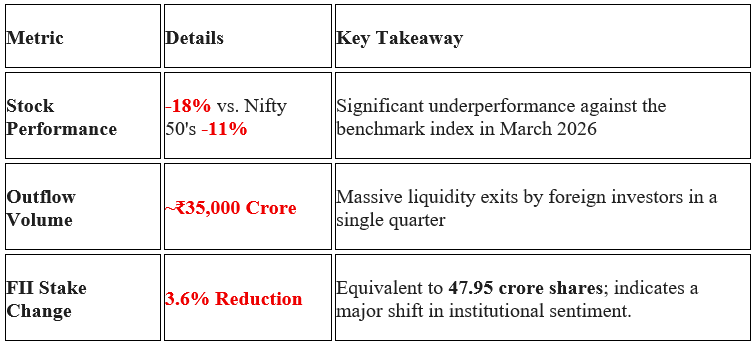
While the bank’s core fundamentals—advances and deposits—showed 10-12% growth in the recent Q4 business update, the market is currently valuing integrity over interest income.
HDFC Bank Future Outlook: Is the Worst Over?
The RBI continues to recognize AT1 bonds as part of a bank’s capital buffer, but the HDFC Bank episode will likely change how investors view the Indian bond market.
- Selective Demand: Investors will now demand a significantly higher risk premium for AT1 issuances.
- Regulatory Heat: The SEBI is reportedly reviewing the disclosures surrounding the Chairman's resignation to see if material information was suppressed.
- Valuation Game: At current levels, the stock is trading at a significant discount to its historical averages. However, until the "governance overhang" is cleared by a permanent chairman appointment and a clean chit from regulators, the volatility is likely to persist.
The Bottom Line
For long-term investors, HDFC Bank remains a formidable franchise with a deep structural moat. However, the AT1 scandal is a stark reminder that in banking, reputation is the only collateral that truly matters.
While "buying the dip" is a classic value strategy, doing so during a governance crisis requires a level of caution that balances price against integrity.
HDFC Bank Target Price: What the Street Says
Following the lender’s Q4 business update and the recent management upheaval, top brokerage houses have revised their outlooks.
The divergence in targets reflects the current "wait-and-watch" sentiment on the Street:
- Macquarie – Rs 1,200
- Bernstein – Rs 1,150
- BoFA – Rs 950
Cut Through the Noise with LiMo
If you are looking for an unbiased, data-driven assessment of HDFC Bank’s technical support levels and fundamental health, LiMo can provide the clarity you need.

As the world's first AI co-pilot for stock investing, LiMo filters out the headlines to give you actionable entry and exit strategies based on institutional-grade technical indicators.
Analyze HDFC Bank with LiMo.
Frequently Asked Questions (FAQ)
Q: Why did HDFC Bank Chairman Atanu Chakraborty resign?
A: Atanu Chakraborty resigned in March 2026, citing "ethical concerns" and values. He specifically highlighted the bank's delayed action regarding the mis-selling of AT1 bonds at the DIFC branch and disagreed with the management's classification of the issue as a mere "technical lapse."
Q: What is the HDFC Bank AT1 bond controversy?
A: The controversy involves allegations that HDFC Bank executives mis-sold Additional Tier-1 (AT1) bonds to investors by pitching them in ways that left some investors unclear about the underlying risks. Following a review of its Dubai (DIFC) operations, the bank penalized 15 officials for gaps in client-onboarding and risk disclosure.
Q: Are AT1 bonds safe for retail investors?
A: AT1 bonds are high-risk, perpetual instruments. Unlike fixed deposits, they can be written down or converted to equity if a bank’s capital falls below regulatory limits. They are generally suited for institutional investors who understand "loss-absorption" features.
Q: Why is HDFC Bank's share price falling in 2026?
A: The stock has corrected over 22% in 2026 so far due to heavy FII selling (~₹35,000 crore), governance concerns following the Chairman’s resignation and regulatory scrutiny over sales practices.
Q: Is HDFC Bank stock a 'Value Buy' after the 2026 crash?
A: While the bank's core business remains strong with steady credit growth, the stock is currently under a "governance overhang." Historically, such crises provide long-term entry points, but the stock remains volatile until leadership stability is restored.
Disclaimer: This article is solely for educational purposes. The securities / investments quoted here are not recommendatory. Investors are advised to consult with their financial advisors before making any investment decisions.
For detailed Disclaimer, please visit our website https://liquide.life/